Shaggy Yamato fellow
| Shaggy Yamato fellow | ||||||||||||||||||||||||||||||
|---|---|---|---|---|---|---|---|---|---|---|---|---|---|---|---|---|---|---|---|---|---|---|---|---|---|---|---|---|---|---|
| Maintenance situation evaluation | ||||||||||||||||||||||||||||||
DATA DEFICIENT (IUCN Red List Ver. 2.3 (1994))  | ||||||||||||||||||||||||||||||
| Classification | ||||||||||||||||||||||||||||||
| ||||||||||||||||||||||||||||||
| Scientific name | ||||||||||||||||||||||||||||||
| Japonia shigetai Minato, 1985 [1] | ||||||||||||||||||||||||||||||
| Japanese name | ||||||||||||||||||||||||||||||
| Shaggy Yamato fellow |
Kind of the conch of the land products that the Yamato fellows (shaggy Yamato shellfish, scientific name Japonia shigetai [1]) are classified in the Yamato fellow genus of the mountain mud snail department shaggily. A Japanese endemic species to be distributed over the Tokara Islands. The husk list has a large number of hair-formed projections, and the Japanese name is derived from this. 献名 to Hiroo Shigeta that specific epithet shigetai gathered the type specimen of this seed.
Table of contents
Distribution
The Tokara Islands: Kuchinoshima (type locality), Nakanoshima, Hirashima, Akusekijima [1].
Form
The shell is higher husk, the cone that around 5mm, a husk are slightly only lower than husk diameter with the husk diameter. As for the quality of husk, a hair-formed projection develops to a husk list thinly. The husk color is dark reddish-brown, but it is blackish and is seen by the soil which attached to a color and husk list of the soft body seen through at the time of the life.
The womb husk smoothes it with two levels and is shiny subtly. 螺層 puts a womb husk, and there are approximately 5.5 levels, and the section of 螺管 is approximately circular, and, in 各螺層, sutures are well remarkable deeply to grow it. The shell epidermis creates laminated 縦褶 at regular intervals, and each 縦褶 has four hair form projections that the tip spread out into a spoon form. I form four lines of hair-formed projections line to form a line in 螺状 in the whole because this structure continues. Four lines of breakdowns are one line in one line, the top and bottom each at one line, the husk bottom in the fringe. There is 3-4 螺条 between each hair-formed projection row. But a hair-formed projection is often lost in an individual and the death shellfishs which matured.
The fauces relationship is simple thinly in 成貝. The navel hole is size of the 1/5 degree of the difference husk diameter clearly.
多旋型 [1] of the chitin which the cover is circular, and is thin [2].
Habits
I inhabit within forest around the laurel forest and the fallen leaves layer is thick and is seen in between the rocks under the fallen leaves layer and fallen leaves of the slightly wet forest floor [2]. The shellfish of the mountain mud snail department eats plant corpses generally and dioecism copulates and lays eggs.
Classification
- Original mention
- Japonia shigetai Minato, 1985, Venus 44 (2): 81-86, figs. 1-3.[1]
- 献名 to Hiroo Shigeta of the natural student, cause elementary school teacher resident in Oshima, Amami where the specific epithet gathered the type specimen of this seed.
- Type locality
- Kagoshima Tokara Islands Nakanoshima Nakanoshima, Tokara Islands, Kagoshima-ken, Japan.
- Type specimen
- Jolo type: Husk high 4.8mm husk diameter 4.4mm (National Science Museum possession NSMT-Mo 61595)
- Para-type: Husk high 5.1mm husk diameter 5.0mm (National Science Museum possession NSMT-Mo 61596)
- Para-type: Husk high 4.7mm husk diameter 4.9mm (Hiroshi Minato individual possession No. 21899)
- Resemblance class
- There is eight kinds of Yamato fellow genus recorded by Japan (+1 subspecies) and it is two kinds of follows that have a spoon-formed hair form projection like this kind soon (+1 subspecies), but is distinguished from shaggy Yamato fellow having four lines because the hair form projection line is all two lines [1]. In addition, the thing reported in the name of ツヅレヤマトガイ from Kuchinoshima in the past is estimated when the shell epidermises of the Yamato fellow were produced shaggily [2].
-
- I am distributed over the Inoue Yamato fellow Japnoia inouei Kuroda & Habe in Habe, 1961 - - Kii peninsula.
- I am distributed over Tokuno SHIMAYA mark fellow Japonia tokunoshimana tokunoshimana Pilsbry & Hirase, 1904 - - Tokunoshima.
- I am distributed over オキノエラブヤマトガイ Japonia tokunoshmana okinoerabuensis Minato, 1974 - - Okinoerabujima.
with the person of relationships
The direct relations are not known, but habitats decrease, and it is said that populations suddenly decrease by the deforestion by the human being [2].
Red List publication situation
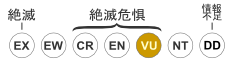
With the second and the third Ministry of the Environment Red List associate; was considered to be endangered (NT), but was considered to be endangered II (VU) with the fourth Red List (2012 publication).
- Endangered II (VU) (Ministry of the Environment Red List)
Source
- ^ a b c d e f Hiroshi Minato Minato, Hiroshi (1985). "2 new kinds of the Yamato fellow genus from Japan.Two New Japonia (Prosobranchia: Cyclophoridae) from Japan." Conchology magazine Venus: the Japanese journal of malacolog 44 (2): 81-86. NAID 110004764646.
- ^ a b c d e Kiyoshi Tomiyama measure, west Kunio (2003). Shaggy Yamato fellow (p.349) in Kagoshima environment life department environmental protection section (plan, editing) "endangered wild animals and plants - Kagoshima Red Data Book animal - of Kagoshima." It is pp. association of Kagoshima environmental technology Foundation 644 (p.349, 603). ISBN 4-9901588-0-6.
This article is taken from the Japanese Wikipedia Shaggy Yamato fellow
This article is distributed by cc-by-sa or GFDL license in accordance with the provisions of Wikipedia.
In addition, Tranpedia is simply not responsible for any show is only by translating the writings of foreign licenses that are compatible with CC-BY-SA license information.
0 개의 댓글:
댓글 쓰기