オオメメダイ department
| オオメメダイ department | ||||||||||||||||||||||||||||||
|---|---|---|---|---|---|---|---|---|---|---|---|---|---|---|---|---|---|---|---|---|---|---|---|---|---|---|---|---|---|---|
 Ariomma bondi | ||||||||||||||||||||||||||||||
| Classification | ||||||||||||||||||||||||||||||
| ||||||||||||||||||||||||||||||
| Fame | ||||||||||||||||||||||||||||||
| Ariommatids | ||||||||||||||||||||||||||||||
| Subdivision | ||||||||||||||||||||||||||||||
| Cf. text |
One of the taxa of the fish that the オオメメダイ department (a scientific name: Ariommatidae) belongs to a sea bass eyes harvest fish suborder. Only the オオメメダイ genus consists of 1 genus, and seven kinds including オオメメダイ are listed [1]. The origin of the course name from "ari" (was superior) and "omma" (eyes) of the Greek [2].
Table of contents
Distribution, habits
All the fish of the オオメメダイ department are distributed over the Atlantic and the Indian Ocean between the North and South American Continent east bank and the African Continent west coast and the Pacific (they assume ケルマディック archipelago, the Hawaiian Islands the east end) in saltwater fish [1]. It is a group of the tropical zone, the deep-sea fish living in the deep sea of the subtropical level and does depth of the water 1,000m with a main habitation range [2].
仔魚 sends floating life on the outer layer and moves to the deep sea with growth [2]. The adult fish has many kinds to be distributed over a continental shelf, the continental slope of the sand mud bottom, and the neighborhood of bottom of the sea is considered to swim, and to live [2]. The eating habit preys on small Crustacea in flesh-eating mainly [2]. Some kinds form a big group and are used as a food fish [2].
Form
It is flat, and the friend of the オオメメダイ department has the figure that I made 側扁 in right and left [1]. There are many kinds of around 30cm in length, but may reach 80cm in total length with the biggest kind [2].
There are two dorsal fins, and, 10-12 slim splinter articles, the second dorsal fin is 14-18 soft articles, and the first dorsal fin is comprised [1]. From the splinter article that three of them have a short anal fin and 13-16 soft articles the pectoral a 20-24 soft article [1]. I include an upheaval (keel) of the low fleshy substance of the length that equalled two lines in the peduncle part, and it is in a differentiation point with the closely related squaretail department (only as for one line of peduncle upheaval) [1]. The adult fish is distinguished from harvest fish department belonging to the same harvest fish suborder having a ventral fin [1]. 30-32 vertebras.
Classification

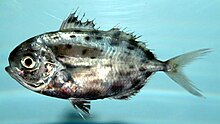
Seven kinds of 1 genus is accepted in a system of Nelson(2006) in オオメメダイ department [1]. In this report, I list it about eight kinds of 1 genus listed in FishBase [2].
- オオメメダイ genus Ariomma
- オオメメダイ Ariomma luridum
- Circle harvest fish Ariomma indicum
- Minami Ocycrius japonicus Ariomma brevimanum
- Ariomma bondi
- Ariomma dollfusi
- Ariomma melanum
- Ariomma parini
- Ariomma regulus
The source, footnote
References


- Joseph S. Nelson "Fishes of the World Fourth Edition" Wiley & Sons, Inc. 2006 ISBN 0-471-25031-7
- Shu Okamura, Kunio Amaoka supervision "saltwater fish Yama-Kei Publishers 1997 ISBN 4-635-09027-2 of Japan"
Outside link
- FishBase- オオメメダイ department (English)
This article is taken from the Japanese Wikipedia オオメメダイ department
This article is distributed by cc-by-sa or GFDL license in accordance with the provisions of Wikipedia.
In addition, Tranpedia is simply not responsible for any show is only by translating the writings of foreign licenses that are compatible with CC-BY-SA license information.
0 개의 댓글:
댓글 쓰기