M72 (the heavenly bodies)
| M72 Messier 72 | |
|---|---|
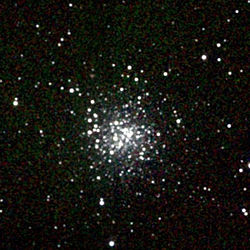 | |
| Globular cluster M72 | |
| Temporary mark, another name | NGC 6981 |
| Constellation | Aquarius |
| Apparent magnitude (V) | 8.96[1] |
| Apparent diameter | 6.6'[2] |
| Classification | Globular cluster [1] |
| Discovery | |
| Discovery day | August, 1780 29-30 days [2] |
| Detector | Pierre メシャン [2] |
| Discovery method | Observation with the telescope |
| Position Epoch: J2000.0[1] | |
| Right ascension (RA,α) | 20h 06m 04.841s [1] |
| Declination (Dec,δ) | -21° 55′ 20.14″[1] |
| Red shift | -0.000963[1] |
| Radial velocity (Rv) | -288.8km/s [1] |
| Proper motion (μ) | Right ascension: 2.25 milliseconds / year [1] Declination: -5.69 milliseconds / year [1] |
| Distance | 55,400 light-year [2] |
 | |
| Position of M72 | |
| Physical property | |
| Diameter | Approximately 106 light-year [2] |
| The other name | |
| The other name | Mel 233 |
| ■Project ■ Template | |
Coordinate:  -12 degrees 32'14.3"M72 (NGC 6981) is a globular cluster in Aquarius for 53m 27.70s for 20h.
Summary
It is a globular cluster having low intensive degree. 49 variable stars are confirmed in 2013 [2].
It is round with the telescope of diameter 5cm small. It does not show the light and shade with vanity, no structure at 10cm into a circular nebula form, too. Mullahs observe a state becoming rough with a telescope of diameter 10cm. A star can slightly finally see a blister at diameter 20cm. When a condition is good, a star becomes able to separate with a telescope and high magnification of diameter 30cm.
History of observation
I was discovered from August 29, 1780 through 30th by Pierre メシャン [2], and Charles Messier listed it in a catalogue after confirmation in October of the year [2]. Messier said, "I am seen subtly almost as same as M71 where I discovered it on the neck of Capricornus, and メシャン preceded." [3]. William Hershel was 40 feet of telescopes and said, "it was the round star cluster of the very bright external form, and a slight star was wound up apart from the center, and the centers awfully crowded, but a star was seen if I well warned you, and intensity of light of the star in the field of vision was various and was different from the light star which usually formed star clusters, but it is thought that there might be such a star to such a star cluster" in 1810 [3]. Smith said, "many stars were seen in the field of vision the globular cluster which slight stars gathered for, and a twin double star continued close to a star cluster, and there is M73 in south 7'" [3].
Source
- ^ a b c d e f g h i "SIMBAD Astronomical Database". Results for NAME M72. March 12, 2016 reading.
- ^ a b c d e f g h Hartmut Frommert, Christine Kronberg (April 9, 2014). "Messier Object 72". SEDS. March 12, 2016 reading.
- ^ a b c Hartmut Frommert, Christine Kronberg (March 30, 2005). "Messier 72 Observations and Descriptions". SEDS. March 12, 2016 reading.
This article is taken from the Japanese Wikipedia M72 (the heavenly bodies)
This article is distributed by cc-by-sa or GFDL license in accordance with the provisions of Wikipedia.
In addition, Tranpedia is simply not responsible for any show is only by translating the writings of foreign licenses that are compatible with CC-BY-SA license information.
0 개의 댓글:
댓글 쓰기