ルペストリス class
| ルペストリス class | ||||||||||||||||||||||||
|---|---|---|---|---|---|---|---|---|---|---|---|---|---|---|---|---|---|---|---|---|---|---|---|---|
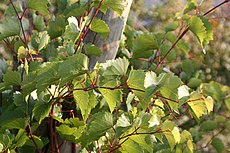 ルペストリス class (sand grape) | ||||||||||||||||||||||||
| Classification | ||||||||||||||||||||||||
| ||||||||||||||||||||||||
| Scientific name | ||||||||||||||||||||||||
| Vitis rupestris | ||||||||||||||||||||||||
| Japanese name | ||||||||||||||||||||||||
| ルペストリス class | ||||||||||||||||||||||||
| Fame | ||||||||||||||||||||||||
| sand grape |
It is kind of the grape growing wild in Southwestern U.S., and the ルペストリス class is known by the name of a sand grape (fame: sand grape). Because a grafted tree is easy, with phylloxera resistance, it is used as a stock (as a kind with Saint Georgia) of the cultivation grape (European grape) in Europe, California. The ルペストリス class was discovered in the rocky place of the gravel-formed stream bed. I do not unusually coil myself with a string in the friends of the grape and become independent like a shrub. They were ever seen from Tennessee to Texas, but they decrease sharply by pasturage, and only northern part of Arkansas, Missouri downstate, Tennessee are seen now. The leaf is hairlessness, the shape that bent inward by the external form such as the bean small [1]. The own cloth for ルペストリス class decreases rapidly, and they were gathered as a specimen once in 60 areas of ten states, but only 24 places of nine states are seen now [2].
Source
- ^ "Viticulture Information - UC Integrated Viticulture Online." January 30, 2013 reading.
- ^ Becker, et al., Hank. "Why In Situ?". USDA. January 30, 2013 reading.
Outside link

This article is taken from the Japanese Wikipedia ルペストリス class
This article is distributed by cc-by-sa or GFDL license in accordance with the provisions of Wikipedia.
In addition, Tranpedia is simply not responsible for any show is only by translating the writings of foreign licenses that are compatible with CC-BY-SA license information.
0 개의 댓글:
댓글 쓰기