East Takashima Station
| East Takashima Station | |
|---|---|
 East Takashima Station (August 2, 2007) | |
| ひがしたかしま - Higashi Takasima | |
| ◄Tsurumi (5.6km) (2.9km) Sakuragicho► | |
| The location | Yokohama-shiKanagawa-ku4, Hoshinocho |
| Position company | Japan Freight Railway Co. (JR freight) |
| Position route | Tokaido Main Line freight branch line (Takashima Line) |
| Distance in kilometers | 5.6km (the Tsurumi starting point) |
| Telegram cable address | Water caltrop |
| Station structure | Station above the ground |
| The opening of business date | It is October 1 (1924) for 1,924 years |
| Remarks | Station for exclusive use of the freight |
| East Takashima Station | |
|---|---|
| ひがしたかしま - Higashi Takasima | |
| Position company | Japanese National Railways (Japanese National Railways) |
| Entry of route | |
| Position route | Tokaido Main Line freight branch line |
| Distance in kilometers | 1.5km (the Higashikanagawa starting point) |
| ◄Higashikanagawa (1.5km) | |
| Position route | Tokaido Main Line freight branch line |
| Distance in kilometers | 0.0km (the east Takashima starting point) |
| (1.2km) Yokohama market► | |
| Position route | Tokaido Main Line freight branch line |
| Distance in kilometers | 0.0km (the east Takashima starting point) |
| (2.2km) Mizuho► | |
East Takashima Station (I come Takashi Higashi ago) is a freight station of Japan Freight Railway Co. (JR freight) at 4, Hoshinocho, Kanagawa-ku, Yokohama-shi, Kanagawa. The Tokaido Main Line freight branch line (popular name Takashima Line) is located above. It becomes the temporary handling station of the car handling freight, and the departure and arrival of the freight train disappears now. I exist on the east side of our station and explain 1,000 young signal boxes (ちわかしんごうじょう) which is unified by our station, and became the abolition once.
Table of contents
Station summary
In Tsurumi, in double track, Sakuragi Machikata, it is a single line in the Takashima Line that is the goods line which links Sakuragicho to Tsurumi from our station at the station which is between it. Furthermore, some freight trains change a driving stop and top and bottom at our station in substitution for Sakuragicho Station where there is not the normal driving stop because the point connects to Negishi Line of the high-density driving route from Sakuragicho Station. Our station does not have the departure and arrival results of the freight at a degree last (2005) 2005 [1] and functions only as a signal box.
I diverged from the old 1,000 young signal box (this station yard handling) of the east side of the station, and the US base "Yokohama north dock" dedicated line where I converted a freight branch line to ex-Mizuho Station into residing in Japan was used for fuel transportation once. The routes from the dedicated line to a wharf of Yokohama Soko diverge, and [2] introduced in a web page of the company has not been already used for this either.
Similarly the dedicated lines from an old 1,000 young signal box to Nippon Flour Mills Co., Ltd. Yokohama factory existed, and shipment of the wheat using the ホキ 2200 form was performed [3]; [4]. In addition, the factory performs transport by rail of the wheat flour in form to transport to the neighborhood freight station by a truck using ホッパコンテナ now [5].
A freight branch line to Yokohama Ichiba Station that was in the Chuo, Yokohama-shi wholesale market home diverged until (1982) in 1982. In addition, separately from it, the dedicated line which went existed to a market fruits and vegetables ridge nearer the station. The freight branch line toward Higashi-Kanagawa Station diverges until (1959) in 1959, and an iron bridge suffering from the canal of the abolished line trace remains near the station. A lot of freight trains of this station reserve existed once, too.
-

The station yard (I photograph it from a railroad crossing)
-
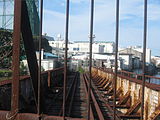
The track trace which has ever diverged from Higashikanagawa
History
I explain it including the history of 1,000 young signal boxes.
When, as for a track having been laid first near our station, Yokohama railroad (Japanese National Railways, JR Yokohama Line in the back) extended a goods line from Higashi-Kanagawa Station. A track from Higashikanagawa was extended (1910) in October in 1910, and sea Kanagawa Station established on the shore side started a business formally (1911) on December 10 in 1911. This aimed at the communication with a warehouse and the quay of Yokohama Soko which the founder group of the Yokohama railroad ran particularly [6]; [7]. Yokohama Soko fills up the reclaimed land of 2, Chiwakacho that Takashima Line passes today [8]. Japanese National Railways leased this route from the first and was open, but was nationalized formally (1917) on October 1 in 1917 [9]. The distance in kilometers of the Kaijin Nagawa signal box was 5.2km with the value after the shift in metric system later from Tsurumi [10].
The goods line of the double track which linked Takashima to Tsurumi was inaugurated (1917) afterwards on June 17 in 1917. At this time, in 2, Chiwakacho, the grade crossing with the branch line to Kaijin Nagawa of the Yokohama railroad occurred, and Kaijin Nagawa signal box (うみかながわしんごうあつかいじょ) was established. This signal tower was handled as the sea Kanagawa Station yard formally [11]; [10]. Originally the site where east Takashima Station will be installed in later was developed land for as Daiba, Kanagawa, and cover up seed with soil on the top; and through the track [12]. In addition, the connecting line which bound Higashikanagawa and Takashima together was inaugurated with this goods line having been inaugurated on the same day. It was a purpose that this connecting line let a freight train of Yokohama Line go through to Takashima [11]. I was divided parallel to a branch line to Kaijin Nagawa on the way for a while from Higashikanagawa and knew it parallel to the double track of the Takashima & Co., Ltd. line in 3 lines to Takashima & Co., Ltd. from the area where east Takashima Station would be installed in later [13].
In the Kaijin Nagawa signal box, I started the handling of the freight which arrived and departed to a dedicated line on February 1 (1923) in 1923. It became 1,000 young signal boxes (ちわかしんごうじょう) independently (1924) from sea Kanagawa Station on January 1 in 1924 [10].
The Great Kanto Earthquake was generated (1923) on September 1 1923, and served as the revival, and east Takashima Station opened it (1924) as a station on the freight branch line between Higashikanagawa - Takashima & Co., Ltd. on October 1 1924 [10]; [14]. East Takashima Station was surrounded by canals around the yard and was intended to treat land and water communication freight mainly, and to supplement Takashima Station and sea Kanagawa Station [14]. The distance in kilometers was 1.0km from 1.5km, Takashima from Higashikanagawa [10].
A goods line of 2.6km to link Yamanouchicho (Yokohama market in the back) to Takashima (1934) on June 15 in 1934 was inaugurated. [10]. It was a goods line from Takashima nominally, but I really diverged from 1,000 young signal boxes and was structure to turn to the south there, and to know Yokohama Ichiba Station parallel to the main line to the east Takashima yard [15]. In addition, I started the real freight handling on January 2 before the official opening of business (1931) in 1931 [10].
The goods line of 2.8km to link Mizuho to the inlet (1935) on July 15 in 1935 was inaugurated [10]. After all this really diverged in 1,000 young signal boxes, too [3]. Sea Kanagawa Station moves to the north side than Takashima Line these days from the south side, and it is estimated that a grade crossing disappeared, but it becomes unknown when it was moved [16].
I belonged to the station on the Takashima line, and east Takashima Station was changed (1955) on January 17 in 1955 by the station of the branch line between previous Higashikanagawa - Takashima. On the same day, 1,000 young signal boxes were unified to east Takashima Station and became the abolition. The line from Higashikanagawa became the east Takashima terminal, and, with this, 1.0km between east Takashima - Takashima was shortened. In addition, the branch line to Mizuho was changed from the inlet Station divergence to the east Takashima Station divergence, too, and full length was changed from 2.8km to 2.2km. The branch line to the Yokohama market was changed from the Takashima Station divergence to the east Takashima Station divergence, too, and full length was changed from 2.6km to 1.2km [10].
However, the goods line which linked east Takashima to Higashikanagawa with a freight transport volume decrease in Yokohama Line became needless, and it was the abolition (1959) on April 1 in 1959. Sea Kanagawa Station becomes the abolition on that day [17]. Furthermore, as for the freight branch line which knew Mizuho Station that was at Mizuho Wharf that the United States Armed Forces occupied it and came to use, it was the abolition (1958) for a route of Japanese National Railways on May 1 in 1958. The use as the dedicated line of the United States Armed Forces wants to be continued afterwards [18]; [10].
The carriage of goods of the Yokohama harbor railroad connection decreased with a change in the form of the carriage of goods, and the freight branch line to the Yokohama market became the abolition (1982) afterwards on November 15 in 1982, too [19].
It became the Japan Freight Railway Co. (JR freight) station by Japanese National Railways division and privatization (1987) on April 1 in 1987. Adjacent Takashima Station became the abolition (1995) on February 27 in 1995, and east Takashima - Takashima interval was made a single line at the same time. East Takashima Station in this way becomes a double track and the connected station of the single line [20].
Chronological table
- 1917(The Taisho eraSix years)
- June 17 - Kaijin Nagawa signal box establishment. The grade crossing point of the freight branch line which links Higashi-Kanagawa Station and sea Kanagawa Station to the Takashima Line. Sea Kanagawa Station yard handling. The connecting line which links Takashima Station to Higashi-Kanagawa Station is inaugurated.
- - Yokohama railroad is nationalized formally on October 1.
- I start the handling of - dedicated line departure and arrival freight (1923) on February 1 in 1923.
- 1924 (1924)
- It is diverged the opening to traffic between - Takashima - Yamanouchicho substantially (1934) in 1,000 young signal boxes on June 15 in 1934.
- It is diverged the opening to traffic between - inlet - Mizuho substantially (1935) in 1,000 young signal boxes on July 15 in 1935.
- I unify 1,000 young signal boxes which change the position of - east Takashima Station to the Takashima Line (1955) on January 17 in 1955 [21]. A branch line to Mizuho, the branch line to the Yokohama market become handled as this station divergence. A branch line from Higashikanagawa becomes our station terminal.
- A freight branch line to - Mizuho Station converts it into the abolition [22], U.S. Forces in Japan dedicated line (1958) on May 1 in 1958. I assume a business range small-lot consignment and car handling freight (but the small-lot consignment freight is limited to a thing of the station connection stationary forces dedicated line departure and arrival.) [23].
- A freight branch line to - Higashi-Kanagawa Station abolishes it (1959) on April 1 in 1959 [24].
- 1970 (1970)
- September 15 - Takashima line electrification opening of business.
- I start the freight train traction with - electric locomotive on October 1.
- A freight branch line to - Yokohama Ichiba Station abolishes it (1982) on November 15 in 1982 [25].
- It becomes the Japan Freight Railway Co. station by - Japanese National Railways division and privatization (1987) on April 1 in 1987.
- During our - station and Takashima Station is a single-lining (1995) on February 27 for 1,995 years.
Use situation
The past annual departure and arrival tonnage according to the follows. There are not the departure and arrival results last in 2005 [1].
| The year | Annual freight traffic [1] | |
|---|---|---|
| Shipment (ton) | Arrival (ton) | |
| 1998 | 38,092 | 600 |
| 1999 | 28,020 | 300 |
| 2000 | 872 | 432 |
| 2001 | 352 | 332 |
| 2002 | 206 | 120 |
| 2003 | 132 | 124 |
| 2004 | 16 | 12 |
| 2005 | 24 | 24 |
| 2006 | - | - |
Around station
Close to our station, there is the cotton harbor district of the redevelopment area. In addition, even an area (east Takashima Station north district) spreading out between the Higashi-Kanagawa Station area is considered for redevelopment.
- Nippon Express Minato Mirai pelican center
- Chuo, Yokohama-shi wholesale market
- Kanagawa water reproduction center (sea Kanagawa Station ruins)
- Mitsui Warehouse Yokohama branch 1,000 young establishment
- Nippon Flour Mills Co., Ltd. Yokohama factory
- Yokohama Port Mizuho Wharf
- 横浜港鈴繁埠頭
- 横浜倉庫鈴繁埠頭営業所
Other
For the purpose of check, the maintenance such as approximately 1.2 times a week, a point or the facilities of the station yard, the work train with the DE10 form diesel which let a linesman conduct it from Tsurumi Line Ogimachi Station arrives and departs. The flatcar for the rail transportation was rarely connected (2000) until in 2000, too, but I let a linesman conduct an airplane making a lone flight now and perform work such as the lubrication to a point mainly.
A request of becoming it is given by the local local governments and, as for the Tokaido Main Line freight branch line (popular name Takashima Line) via our station, is placed freight and passengers (freight and traveler) combination as "the route that should examine maintenance in future" in the Transport Policy Council report 18th (2000) with Tokaido goods line partly. When becoming it realizes a passenger level, in addition, may connect it to Shinagawa, the Tokyoteleport (Odaiba) area of there or the Tokyo International Airport (Haneda Airport) area in the section of Takashima lines from Sakuragicho to Tsurumi [26]; [27] (as for "Tokaido goods line # traveler design, plan" reference).
The next station
- East Japan Railway Co.
- Tokaido Main Line freight branch line (Takashima Line)
- Tsurumi Station - east Takashima Station - Sakuragicho Station
Footnote
- ^ a b c "Yokohama-shi statistics portal (transportation)". Yokohama-shi (January 18, 2012). March 18, 2012 reading.
- ^ "鈴繁埠頭営業所." Yokohama Soko. March 18, 2012 reading.
- ^ a b "Times p.171 of the train for exclusive use of the Allied Forces"
- ^ "history and present conditions p.49 of the Yokohama harbor railroad"
- ^ "Distribution partnership promotion business spread business first promotion decision business authorization green in 2006 (PDF)". Ministry of Land, Infrastructure and Transport (May 16, 2006). March 18, 2012 reading.
- ^ "railroad pp.62 -64 of Kanagawa"
- ^ "railroad story p.70 of Yokohama"
- ^ "times p.168 of the train for exclusive use of the Allied Forces"
- ^ "History of Japanese National Railways 100 years" Vol. 6 pp.521 -523
- ^ a b c d e f g h i j It depends on the clause of "the station change size encyclopedia" concerned
- ^ a b "Trace p.15 of the Yokohama harbor railroad"
- ^ "times p.172 of the train for exclusive use of the Allied Forces"
- ^ "times pp.174 -175 of the train for exclusive use of the Allied Forces"
- ^ a b 9 "history of Japanese National Railways 100 years" p.252
- ^ "times p.169 of the train for exclusive use of the Allied Forces"
- ^ "history and present conditions pp.42 -43 of the Yokohama harbor railroad"
- ^ "trace p.22 of the Yokohama harbor railroad"
- ^ "times pp.171 -172 of the train for exclusive use of the Allied Forces"
- ^ "trace p.26 of the Yokohama harbor railroad"
- ^ "history and present conditions p.46 of the Yokohama harbor railroad"
- It is January 14 Japanese National Railways public announcement 14th (1955) for ^ 1,955 years
- It is April 26 Japanese National Railways public announcement 144th (1958) for ^ 1,958 years
- It is April 26 Japanese National Railways public announcement 145th (1958) for ^ 1,958 years
- It is March 28 Japanese National Railways public announcement 85th (1959) for ^ 1,959 years
- It is November 13 Japanese National Railways public announcement 166th (1982) for ^ 1,982 years
- Use ^ Tokaido freight branch line freight and passengers together; a maintenance examination meeting (official site)
- One or - - goods line traveler who can realize effectively utilizing it of ^ passing away assets expectation and a problem (the Business Media truth: on 時事日想 March 29, 2013 of Junnichi Sugiyama) of becoming it
References
Bookm
- On "station change serious matter celebration Japanese National Railways, JR" JTB, October 1, 1998, it is a first edition.
- On "railroad 1872-1996 Masaho Noda of Kanagawa", Katsumasa Harada, 1, Sakae, Aoki, Yoshinobu Oikawa, Japanese economy criticism company, September 10, 1996, it is the first edition. ISBN 4-8188-0830-X。
- On Hirokazu Hasegawa "railroad story JTB publishing of Yokohama", November 1, 2004, it is a first edition. ISBN 4-533-05622-9。
- On Masaki Kawahara "times light person company of the train for exclusive use of the Allied Forces", June 8, 2000, it is the second impression. ISBN 4-7698-0954-9。
- "History of Japanese National Railways 100 years" 6, Japanese National Railways, October 1, 1972.
- "History of Japanese National Railways 100 years" 9, Japanese National Railways, March 25, 1972.
Magazine article, article
- The Hirokazu Hasegawa "trace of the Yokohama harbor railroad," it is 13-30 pages on "rail" 27th, Eri ray publishing division press crampons barn, April 23, 1990.
- The Ryo Yamada "history and present conditions of the Yokohama harbor railroad," it is 41-49 pages in "railroad PICT rial" 714th, electric car meeting for the study, March, 2002.
Allied item

This article is taken from the Japanese Wikipedia East Takashima Station
This article is distributed by cc-by-sa or GFDL license in accordance with the provisions of Wikipedia.
In addition, Tranpedia is simply not responsible for any show is only by translating the writings of foreign licenses that are compatible with CC-BY-SA license information.
0 개의 댓글:
댓글 쓰기