Toyota, TR engine
| Toyota, TR engine | |
|---|---|
| Production base | Toyota Motor Corporation |
| Production period | As of 2003 - |
| Type | Inline four-cylinder DOHC16 valve |
| Displacement volume | 2.0L 2.7L |
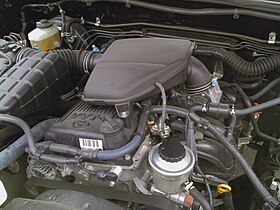
Toyota, the TR engine is a system of the water-cooled inline four-cylinder gasoline engine of Toyota Motor Corporation.
SUV, a pickup truck, a station wagon, the vehicle gross weight including the taxi become the design that made much of low 中速域 torque in consideration of the use by a car model of around 2.5 tons and the duties use. I follow the basic design of the conventional RZ type, but basic performance including the lightweighting by adoption of VVT-i and the overuse of resin parts is greatly improved.
Table of contents
Summary
Model
1TR-FE -2000cc
| 1TR-FE | |
|---|---|
| Production period | July, 2003 - |
| Engine classification | Gasoline engine |
| Cooling method | Water-cooled |
| Cylinder placement, number | Inline four-cylinder |
| Valve form | Narrow corner 4 valve DOHC VVT-i Narrow corner 4 valve DOHC Dual VVT-i |
| Fueling device | EFI |
| Displacement volume | 1,998cc |
| Inside diameter X trip | 86.0mm *86.0mm |
| Compression ratio | VVT-i: 9.8:1 Dual VVT-i: 10.4:1 |
| The output | VVT-i: 98kW (133PS)/5,600rpm Dual VVT-i: 100kW (136PS)/5,600rpm |
| Torque | 182Nm(18.6kgm)/4,000rpm |
| Weight | -kg |
- Deployment car model (vehicle model)
1TR-FPE -2000cc
| 1TR-FPE | |
|---|---|
| Production period | November, 2007 - |
| Engine classification | LPG engine |
| Cooling method | Water-cooled |
| Cylinder placement, number | Inline four-cylinder |
| Valve form | Narrow corner 4 valve DOHC VVT-i |
| Fueling device | EFI-LP (electronic control-style LPG liquid jet method) |
| Displacement volume | 1,998cc |
| Inside diameter X trip | 86.0mm *86.0mm |
| Compression ratio | 10.6:1 |
| The output | 85kW (116PS)/4,800rpm (dyna / Toyo ace) |
| Torque | 189Nm(19.3kgm)/3,600rpm |
| Weight | -kg |
It is an engine (electronic control-style LPG liquid jet method) "EFI-LP" (EFI for LPgas) of Toyota's first [1]
- Deployment car model (vehicle model)
- (for the first time) Dyna / Toyo ace (TRY231 .281)
- Crown sedan / crown comfort / comfort (TSS10 system, TSS11 system, August, 2008 -)
2TR-FE -2700cc
| 2TR-FE | |
|---|---|
| Production period | August, 2004 - |
| Engine classification | Gasoline engine |
| Cooling method | Water-cooled |
| Cylinder placement, number | Inline four-cylinder |
| Valve form | Narrow corner 4 valve DOHC VVT-i Narrow corner 4 valve DOHC Dual VVT-i |
| Fueling device | EFI |
| Displacement volume | 2,693cc |
| Inside diameter X trip | 95.0mm *95.0mm |
| Compression ratio | VVT-i: 9.6:1 Dual VVT-i: 10.2:1 |
| The output | VVT-i: 111kW (151PS)/4,800rpm Dual VVT-i: 118kW (160PS)/5,200rpm |
| Torque | VVT-i: 241Nm(24.6kgm)/3,800rpm Dual VVT-i: 243Nm(24.8kgm)/4,000rpm |
| Weight | -kg |
- Deployment car model (vehicle model)
- High ace wagon (TRH200 system)
- Fourth generation cony surf (TRN215W)
- Third generation ランドクルーザープラド (TRJ120 system)
- Fourth generation ランドクルーザープラド (TRJ150 system)
- Third generation ハイメディック (TRH200S system)
- High ace 200/210/220 system
- Land cruiser 120 system
- Cony surf 210 system
- Cony / ハイラックスヴィーゴ
- イノーヴァ
- Hino, デュトロ (TRY232 system)
2TR-FP -2700cc
| 2TR-FP | |
|---|---|
| Production period | - |
| Engine classification | LPG engine |
| Cooling method | Water-cooled |
| Cylinder placement, number | Inline four-cylinder |
| Valve form | - |
| Fueling device | - |
| Displacement volume | 2,693cc |
| Inside diameter X trip | 95.0mm *95.0mm |
| Compression ratio | - |
| The output | - |
| Torque | - |
| Weight | -kg |
- Deployment car model (vehicle model)
- Dyna / Toyo ace
Footnote
- Is ^; in the LPG engine electronic control method in itself is adopted in 1G-GPE (carburetor but electronic control-type as for this).
Allied item

This article is taken from the Japanese Wikipedia Toyota, TR engine
This article is distributed by cc-by-sa or GFDL license in accordance with the provisions of Wikipedia.
In addition, Tranpedia is simply not responsible for any show is only by translating the writings of foreign licenses that are compatible with CC-BY-SA license information.
0 개의 댓글:
댓글 쓰기