Kh-25 (missile)
| Kh-25ML/MLT/MR (NATO identification name: AS-10 Karen) Kh-25MP (AS-12 Kegler) | |
|---|---|
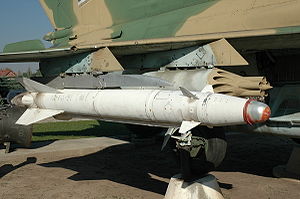 Kh-25ML | |
| Kind | Tactics air-to-ground missile Anti-radar missile (Kh-25MP) |
| Original development country |  The Soviet Union The Soviet Union |
| The operational history | |
| Deployment period | As of 1975 - |
| Deployment |  Russia Russia |
| History of development | |
| Development period | From 1971 to 1975 |
| Manufacturer | Zvezda-Strela |
| Specifications | |
| Weight | Kh-25ML: 299 kg (659 lb)[1] Kh-25MP: 315 kg (694 lb)[2] |
| Full length | Kh-25ML: 370.5cm (12 ft 2 in)[1] Kh-25MP 1VP: 425.5cm (167.5 in)[2] Kh-25MP 2VP: 435.5cm (171.5 in)[2] |
| Diameter | 27.5 cm (10.8 in)[1] |
| | |
| Warhead | High explosive, shell form |
| Quantity of bursting charge | Kh-25MP: 86 kg (190 lb)[2] |
| | |
| Wingspread | 75.5 cm (29.7 in)[1] |
| Instruction method | It is laser, passive radar, TV, IR, satnav, Acty braider by a derivation model |
| Discharge Platform | A MiG-21, it is Su-17/20/22,[3] Su-24,[3] Su-25,[3] Su-27[3] MiG-23/27,[3] MiG-29 [3] [3] Kh-25MP: MiG-23/27,[4] Su-17/22,[4] Su-24,[4] Su-25[4] |
The second generation tactics air-to-ground missile of the Soviet Union (Russia) where Kh-25 (Х-25, NATO code name AS-10 Karen) was developed from the end of 1960s through the 1970s. I seem to be an improved version of Kh-23/66Grom (NATO code name AS-7 Kerry) and resemble closely very much. I comprise modular-type guidance controls, and, as for the range, 10km is [1]. The derivation model of anti-radar missile specifications (Kh-25MP) is known as AS-12 Kegler in NATO, and, as for the range, up to 40km is [2]. Kh-25 designed by Zvezda-Strela is a model derived from Kh-23 (AS-7 Kerry) of laser guidance specifications. The Kh-38 series of the succeeding model inherits it, but Kh-25 is used widely now, too.
Table of contents
Development
Beam riding instruction-type Kh-66 that the air-to-air missile that use was started in 1968 was developed for the cause was air-to-surface missile for the first tactics plane for the Soviet Union [5]. However, it was necessary for the plane to make nose dive at the time of discharge, and use was accompanied with difficulty. Kh-23 which was an electric wave command guidance-type derivation model was examined for the first time in 1968, but I had a problem to guidance controls and needed five years by an operational start [6]. Therefore the work of the derivation model of the cicada active laser seeker was started in 1971 and became Kh-25 [5]. This was known as Kh-23L at first in the Western countries [7]. An examination was started on November 24, 1974, and a mass production contained Kh-25 from 1975 [5]. The work of the derivation model of anti-radar missile specifications from [5]Kh-66 using the passive seeker and SUR-73 automatic pilot was started in 1972 [4].
Kh-31 of the long range vs. the radar missile was done from the same plan, too [5]. I put the examination of Kh-27 on MiG-27 and was made a start [5] on August 8, 1975, but the operational start was September 2, 1980 [5]. The NATO identification name was AS-12 Kegler and rearranged Kh-28 (AS-9 Kyle) [4].
I started work to integrate Kh-23M, Kh-25 and Kh-27 with a single modular system that "Victor Bugaiskii" which was a chief engineer of the design station reduced an expense in 1973 and increased flexibility of the tactics [5]. This work was completed at the end of 1978 [5], and, as a result, Kh-25MP (anti-radar), Kh-25ML (laser guidance) and the Kh-25MR (electric wave instruction) series were possible. NATO appointed these sequentially now as AS-12 and AS-10 though I could easily change a seeker head.
Design
Kh-25 resembles a latter term model of Kh-23 closely in a canard and a wing of the cruciate very much.
A homing head is it in 1VP and 2VP2 kind, and Kh-25MP vs. the radar missile receives different frequency [2].
Operational results
Archetypal Kh-25 was put on MiG-23, MiG-27, Su-17M in Soviet Union Air Force for from 1973 to 1975, and use was started [3].
Thereafter it is confirmed to be used in MiG-21, MiG-29, Su-17/20/22 series, Su-24, Su-25, Su-27 [3]. A helicopter such as Ka-50 is equipped even with equally.
I can put Kh-25MP on MiG-23/27, Su-17/22, Su-24, Su-25 [4].
Data
- Full length: 3.83m (MR), 4.255m (ML)
- A diameter: 27.5cm
- Wingspread: 82cm
- A warhead: 140 kg of HE (MR), 89.6 kg of HE (ML)
- An instruction method: Radio order (MR), cicada active laser (ML)
- A range: 10km (MR), 20km (ML)
- A design: The Zvezda design station
- A main deployment machine: MiG-27、Su-17、Su-20、Su-22、Su-24、Su-25
Version
NATO appoints all Kh-25 series except the anti-radar use as AS-10 Karen. "M" is abbreviation of the "Modulnaya" - module (seeker).
- Kh-25 (Izdeliye 71, Kh-23L)
- A laser guidance type to become the model.
- Kh-25ML
- A cicada active laser guidance type. I penetrate the concrete wall of 1 meter (39 in) of thickness in the thing with the double warhead [8].
- Kh-25MA
- An Acty braider instruction type. I was exported for the first time in 1999 [3].
-
- Kh-25MAE
- It was for update of Kh-25MA, and the export of specifications equipped with the seeker of the Ka- band in August, 2005 was announced. PSM of Phazotron company has the ability that the tank of the 4,000m (4,370 yd) distance is caught, and it is estimated that I am used for Kh-25MA [8].
- Kh-25MT
- A TV instruction type [3].
-
- Kh-25MTP
- An imaging IR instruction type [3].
- Kh-25R/Kh-25MR
- An electric wave command guidance type [3].
- Kh-27 (Kh-27/M, AS-12 Kegler)
- The model model of the anti-radar missile.
- Kh-25MP (AS-12 Kegler)
- The module type vs. the radar missile [4].
-
- Kh-25MPU (AS-12 Kegler)
- Improved Kh-25MP[4].
As for the training bullet, "U" is appointed. There are the following models in Kh-25ML
Similar missile
- Kh-23M () was a model in front of - Kh-25 (AS-7 Kelly), and some techniques were returned by Kh-25.
- I equipped Kh-29 (AS-14 ケッジ) - Kh-25 laser guided missile with a large-scale warhead.
- In Kh-25 of Kh-59 (AS-13 kingbolt) - long range, I was equipped with large-scale warhead and TV instruction.
- A succeeding model of Kh-38 () - Kh-25.
- By a similar lightweight missile managed in the AGM-65 mer Berwick - United States, there are plural guidance controls and warheads.
- The anti-radar missile which is equal to Kh-25MP which the AGM-45 - United States is equipped with.
Footnote
- ^ a b c d e f g h i j "Kh-25ML". Tactical Missiles Corporation (2004). 2010 reading....
- ^ a b c d e f g h "Kh-25MP". Tactical Missiles Corporation (2004). 2010 reading....
- ^ a b c d e f g h i j k l It is read m n "Kh-25" (AS-10 'Karen') on Jane's Air-Launched Weapons, (2008-08-01)l February 7, 2009. [Broken link]
- It is read ^ a b c d e f g h i "Kh-25MP, Kh-25MPU" (AS-12 'Kegler') on Jane's Air-Launched Weapons, (2008-08-01)l February 7, 2009.
- ^ a b c d e f g h i (Word 97 DOC) History of JSC Tactical Missile Corporation, pp. 4–c February 26, 2009 reading.
- ^ Friedman, Norman (1997), The Naval Institute Guide to World Naval Weapons Systems, Naval Institute Press, p. 235, ISBN 97815575026815 2010 reading....
This article is taken from the Japanese Wikipedia Kh-25 (missile)
This article is distributed by cc-by-sa or GFDL license in accordance with the provisions of Wikipedia.
In addition, Tranpedia is simply not responsible for any show is only by translating the writings of foreign licenses that are compatible with CC-BY-SA license information.
0 개의 댓글:
댓글 쓰기