Kepler 20
| Kepler 20 Kepler-20 | |
|---|---|
 | |
| Constellation | Lyra |
| Apparent magnitude (V) | 12.498[1] |
| Classification | G type main sequence star |
| An orbital element and property | |
| The number of planets | 5 |
| Position Epoch: J2000.0 | |
| Right ascension (RA,α) | 19h 10m 47.52s [1] |
| Declination (Dec,δ) | + 42° 20′ 19.4″[1] |
| Distance | 945.4 ± 97.8 ly (290+-30 pc[1][2]) |
| Physical property | |
| Radius | 0.944+0.060 −0.095 R☉[1][2] |
| Surface area | 5.425 × 10¹² km2 |
| Volume | 1.187 × 10¹⁸ km3 |
| Mass | 0.912 +-0.034 M☉[1] |
| Mean density | 1.51 +-0.38 g/cm3 [1] |
| Surface gravity | 4.443 +-0.075 cgs[2] |
| Spectral class | G8 [3] |
| The intensity of light | 0.71+0.14 −0.29 L☉[1] 0.853 +-0.093 L☉[2] |
| Surface temperature | 5,455+-100 K[1] |
| Quantity of metal [Fe/H] | 0.01 ± 0.04[1] |
| Age | 8.8+4.7 −2.7 Gyr[1] |
| The other name | |
| The other name | KOI-70 |
| ■Project ■ Template | |
Kepler 20 (Kepler-20) is a direction of Lyra, a fixed star similar to the sun in the 945 light-year (approximately 290 parsecs) point.
Table of contents
Fixed star
| The sun | Kepler 20 |
|---|---|
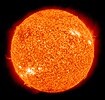 |  |
Kepler 20 is a fixed star similar to the sun of the spectral class G8 type with mass of 0.912 times of the sun, size of 0.944 times. The surface temperature is slightly colder than 5,193 degrees Celsius and the sun. Because the apparent magnitude is ignorant of 12.51 and an emergency, I cannot observe it by the naked eye.
Planet
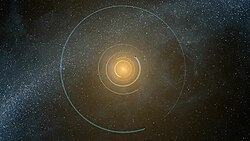
In 2011, the existence of five planets was confirmed by the observation by the transit method with the Kepler space telescope [1]; [2] [3]. Of these, it is estimated that Kepler 20e and Kepler 20f are the earth and extrasolar planets of the about the same size [2]. But surface temperature reaches 1040K (767 degrees Celsius) and 705K (432 degrees Celsius) each, and it is thought that the life does not exist. When mass is hot Neptune of 8.7 - approximately 20 times of the earth, Kepler 20b and Kepler 20c and Kepler 20d are supposed [1].
| Name (order near the fixed star) | Mass | Orbit semimajor axis (Au) | Revolution period (Day) | Orbit eccentricity | Orbit angle of inclination | Radius |
|---|---|---|---|---|---|---|
| b | 8.7+2.1 −2.2 M⊕ | 0.04537+0.00054 −0.00060 | 3.6961219+0.0000043 −0.0000064 | <0.32 | 86.50+0.36 −0.31° | 1.91+0.12 −0.21 R⊕ |
| e | 0.39-1.67 M⊕ | 0.0507+0.0063 −0.0067 | 6.098493+-0.000065 | <0.28 | 87.50+0.33 −0.34° | 0.868+0.074 −0.096 R⊕ |
| c | 16.1+3.3 −3.7 M⊕ | 0.0930+-0.0011 | 10.854092+-0.000013 | <0.40 | 88.39+0.16 −0.14° | 3.07+0.20 −0.31 R⊕ |
| f | 0.66-3.04 M⊕ | 0.11+-0.01 | 19.57706+-0.00052 | <0.32 | 88.68+0.14 −0.17° | 1.03+0.10 −0.13 R⊕ |
| d | <20.1 M⊕ | 0.3453+0.0041 −0.0046 | 77.61185+0.00015 −0.00037 | <0.60 | 89.57+0.043 −0.048° | 2.75+0.17 −0.30 R⊕ |
Source
- ^ a b c d e f g h i j k l m n Thomas N. Gautier,David Charbonneau et al. (February 1, 2012). It is arXiv: "Kepler-20: A Sun-like Star with Three Sub-Neptune Exoplanets and Two Earth-size Candidates" 1112.4514v2 [astro-ph.EP].
- ^ a b c d e f g Francois Fressin,Guillermo Torees et al. (2011). It is arXiv: "Two Earth-sized planets orbiting Kepler-20" 1112.4550v1 [astro-ph.EP]. doi: 10.1038.
- ^ a b The Extrasolar Plnet Encyclopaedia
- "NASA Kepler Discoveries Table". NASA (July 23, 2015). September 3, 2015 reading.
Allied item

This article is taken from the Japanese Wikipedia Kepler 20
This article is distributed by cc-by-sa or GFDL license in accordance with the provisions of Wikipedia.
In addition, Tranpedia is simply not responsible for any show is only by translating the writings of foreign licenses that are compatible with CC-BY-SA license information.
0 개의 댓글:
댓글 쓰기