Green bus
The green bus is community bus of Nerima-ku, Tokyo.
I unified things operated by three kinds of names for this name from original establishment process on July 16, 2009.
Table of contents
Summary
The community bus in Nerima-ku did Nerima-ku shuttle bus for the communication of the administration in the ward, Nerima-ku bus transit experiment set as a circulation bus of the traffic blank area, a bus for the welfare institution pickup with blood relationship and was traveled by three kinds of names of the Nerima-ku welfare community bus which assumed the access to the hospital in the ward the principal objective. On the occasion of the unification of these three kinds of names, services, the nickname of "the green bus" was established.
Of these, Tokyo welfare bus caught the trust of the service after a trial service start about the Nerima-ku welfare community bus from Nerima-ku until March, 2007 in July, 2005 and I received Road Transport Act revision in 2006 in the last year and changed the thing which traveled with 2 of Road Transport Act Article 21 for the service by the public riding together traveler car transport company of Road Transport Act Article 4 from April of the year.
Route
6 following systems are operated. All are suspended for from December 29 to January 3.
- Hoya route (old Nerima-ku shuttle bus)
- Kitamachi route (old Nerima-ku bus transit experiment)
- Seki-cho route (old Nerima-ku welfare community bus)
- Hikawadai route (same as above)
- Oizumi route (same as above)
- Minamioizumi route
In addition, under the influence of fueling circumstances aggravation caused by the 2011 off the Pacific coast of Tohoku Earthquake (the Great East Japan Earthquake), in Kitamachi route, the Hikawadai route, the Hoya route, the Seki-cho route, the Oizumi route became the suspension during from March 16 to March 21 for from March 15, 2011 to March 24.
Hoya route
Service section
- Hoya Station (the south exit) - Minamioizumi - Oizumi third Elementary School - Metropolitan citizens farm - Nagakubo - Doshida area meeting place - Hikarigaoka, Nerima Hospital - Hikarigaoka Station (in front of inhabitant of a ward center)
I start trial service in August, 1991 and shift to full-scale service in April, 1992. The service consigns it to the Seibu bus Kamishakujii Office. From the 6:00 level to the 20:00 level, other time is 19 coming and going service a day in the morning in space every 45 minutes for 30 minutes.
Expansion and the increase of the number of trains to 19 coming and going, the enlargement of the stop were carried out in service time on July 16, 2009. It is a characteristic that there are fewer numbers than a general route bus without being set the stop at the short interval like other community buses in the present when stops were built more between Metropolitan citizens farm - Hikarigaoka, Nerima Hospital, and have a long interval.
Getting off in the Hoya Station south exit getting off ground, the departure from the second platform, the enlargement of the stop on the way were carried out on October 16, 2013 [1]. As Hoya stop, the getting off was the Bank of Tokyo-Mitsubishi UFJ Hoya Branch door on capital way 233 of the station square, and the departure was from the Seibu bus marshaling hall of the neighborhood of 3, Azumacho stop till then. At the Bank of Tokyo-Mitsubishi UFJ Hoya Branch door, the plate which expressed を for exclusive use of the getting off remained in the wall surface of the building after 16th on 10th in 2013, but was in a condition that blue packing tape was stuck on the letter of "the Nerima-ku green bus" of this plate in about May, 2015. In addition, departure and arrival from the Hoya Station north exit is planned after I widen it, and Nerima-ku main pivot ward way Route 67 was maintained [2].
Kitamachi route
Service section
- It is in front of Hikarigaoka Station - Hikarigaoka, Nerima hospital - Nerima seventh branch office → Self-Defense Forces → Kitamachi elementary school → Tobu-Nerima Station entrance → Hikarigaoka Station Nerima 01
- → Kitamachi, Nerima garage → 2, Kitamachi east → Tobu-Nerima Station entrance → Hikarigaoka Station in front of the Nerima 01-2 Hikarigaoka Station - Hikarigaoka, Nerima Hospital - Nerima seventh branch office → Self-Defense Forces
I try it in March, 2003 and travel and start. The service consigns it to the Kokusai Kogyo bus Nerima Office. From the 7:00 level to the 20:00 level, 13 flights a day travel every from 60 to 65. It was the 14th flight service a day before the following course change every 60 minutes.
A course change was carried out on March 25, 2011 and became Kitamachi, Nerima garage way between → 2, Kitamachi east in front of the Self-Defense Forces. But as Kitamachi elementary school way [3] conventional as for three flights in the evening to enter in daytime one flight and the vehicle traffic regulation time of the section concerned. I was going to carry it out at first on March 16, but was postponed under the influence of the suspension mentioned above.
Seki-cho route
Service section
- Institute of - Musashiseki Station south exit - girl entrance - Kami-Shakujii Station - Shakujiikoen - Nerima-Takanodai Station - Juntendo Nerima Hospital in front of Seki-cho welfare garden - Seki inhabitant of a ward center
It travels in form to utilize welfare garden pick-up bus of the Tokyo welfare bus on July 11, 2005 and starts. On the occasion of a change of April, 2007, service is consigned to the Seibu bus Kamishakujii Office.
As for from Seki-cho welfare garden, 12 of them, from Juntendo Nerima Hospital are 11.5 coming and going service a day 11 to the level from the level from the 7:00 level to the 18:00 level in the daytime in the morning every 60 minutes at an interval for 75 minutes at 18:00 at 8:00. There is not the change on the occasion of the name unification to a green bus of diagram.
On March 30, 2011, it was changed the course by way of current Seki inhabitant of a ward center, Musashiseki Station.
Hikawadai route
Service section
- Nerima 02 Kitamachi, Nerima garage → Hikawadai welfare garden → Hikawadai Station → Nerima-Kasugacho Station east → Hikarigaoka Station → Hikarigaoka, Nerima Hospital (in the Nerima synthesis athletic ground - Nerima Station interval, I pass)
- Nerima 02-2 Hikarigaoka, Nerima Hospital → Hikarigaoka Station → Nerima-Kasugacho Station east → Hikawadai Station → Hikawadai welfare garden → Tobu-Nerima Station entrance → Kitamachi, Nerima garage (in the Nerima synthesis athletic ground - Nerima Station interval, I pass)
- Nerima 03 Hikarigaoka, Nerima Hospital - Hikarigaoka Station - Nerima-Kasugacho Station east - Nerima Station - Hikawadai Station - Hikawadai welfare garden - Tobu-Nerima Station entrance
- Nerima 03-2 Kitamachi Elementary School → Tobu-Nerima Station entrance → Hikawadai welfare garden → Hikawadai Station → Nerima Station → Nerima-Kasugacho Station east → Hikarigaoka Station → Hikarigaoka, Nerima Hospital
- Nerima 03-3 Hikarigaoka, Nerima Hospital → Hikarigaoka Station → Nerima-Kasugacho Station east → Hikawadai Station → Hikawadai welfare garden → Tobu-Nerima Station entrance → Hikawadai welfare garden → Hikawadai Station → Nerima Station
- Nerima 03-4 Hikarigaoka, Nerima Hospital → Hikarigaoka Station → Nerima-Kasugacho Station east → Nerima Station → Hikawadai Station → Hikawadai welfare garden → Tobu-Nerima Station entrance → Kitamachi, Nerima garage
- Nerima 03-5 Nerima Station → Hikawadai Station → Hikawadai welfare garden → Tobu-Nerima Station entrance → Hikawadai welfare garden → Hikawadai Station → Nerima Station → Nerima-Kasugacho Station east → Hikarigaoka Station → Hikarigaoka, Nerima Hospital
It travels by the process like the Seki-cho route on July 25, 2005 to be two weeks after Seki-cho route service start and starts it. On the occasion of a change of April, 2007, service is consigned to the Kokusai Kogyo bus Nerima Office.
On April 16, 2014, I was reorganized with the service cancellation of the Kokusai Kogyo bus light 03 system on the course via Nerima Station, Tobu-Nerima Station.
Nerima 02.02-2 does not run in Nerima Station by the service only for the first flight with both directions either. The branch number system on is storage of entrance and exit use (for vehicle traffic regulation time).
By 12-15 service a day, it travels in the daytime every 60 minutes.
Among green bus 3 routes (Hoya, Kitamachi, Hikawadai) to go by way of between Hikarigaoka Station - Hikarigaoka, Nerima Hospital, only this route stops at the "Akane cloud park" stop where a public route on the way stops at.
Oizumi route
Service section
- Service route (counterclockwise direction) in Oizumi-Gakuen Station - Nishioizumi district inhabitant of a ward building - 3, Nishioizumi post office (→ Oizumigakuencho welfare garden entrance → / ← Nishioizumi allotment ←) 5, Oizumigakuencho ※() for one
A January 7, 2008 service start. It travels and consigns it to the Seibu bus Kamishakujii Office from the first.
From the 7:00 level to the 19:00 level, 25 flights a day travel every 30 minutes. There is not the change on the occasion of the name unification to a green bus of diagram.
Minamioizumi route
Service section
- - Seki-cho welfare garden before the Hoya Station entrance - Oizumi second Elementary School - 1, Minamioizumi - 1, Minamioizumi, Nerima post office - 2, Minamioizumi - Ishigami Idaka school north - Musashiseki Station south exit - Seki inhabitant of a ward center
It travels on December 16, 2011 and, by the route where the introduction to the Minamioizumi district was shown with "public transport blank area improvement plan" [4] that Nerima-ku devised in 2008, starts after the discussion with local people. It travels and consigns it to the Seibu bus Kamishakujii Office from the first.
From the 7:00 level to the 19:00 level, Japan and China are 13 coming and going service a day in the morning in space every 60 minutes for 70 minutes. In addition, as for the first flight and night two flights, morning two flights to Hoya Station entrances and 3 coming and going of the last flight from the Hoya Station entrance in total, it is driving between the Hoya Station entrance - Musashiseki Station south exit.
In the Hoya Station entrance stop, as for the arrival, as for the departure, it is in a former Waseda street a Nerima Ward bicycle parking lot ago in Minamioizumi, Nerima-ku place of Hoya route station south side away from the Hoya stop.
Was a course between in front of Hoya Station entrance - Seibu garage which performed Toshin of Fuji Highway, but as a result of having received a request of the communication improvement to Seibu Shinjuku Line, was changed extension at first on the act course that left for Musashiseki Station, the Sekicho welfare garden newly via Omekaido after 西進 did Fuji Highway on March 16, 2013 by the 1, Minamioizumi, Nerima post office [5]; [6].
Fare
- Adult 220 yen, child 110 yen (equality system)
- Payment in PASMO, Suica is possible. (with a chip card in the case of payment adult 216 yen, child 108 yen)
- Tokyo senior pass is available.
- The person who showed a done identification card of the age confirmation in 65 years old or more is 110 yen. The person with a disability who showed a person with a disability notebook is adult 110 yen, child 60 yen.
- By the Seibu bus service route, I can use thing becoming "220 yen business" and "the 230 yen business" (the whole line) among company's "commuting IC commuter pass" (thing to give to PASMO, Suica), company's "study advantageous IC commuter pass" (attending school commuter pass every term) (touching a coin box with an applicable chip card).
- Until March 31, 2015, it was adult 210 yen, child 110 yen (even as for the chip cards such as PASMO the same amount). Until July 31, 2010, the payment by the bus common card was possible, too.
Seki-cho, Hikawadai, the Oizumi root was adult 200 yen, child 100 yen for the old Nerima-ku welfare community bus era. In addition, the Hoya route for the old Nerima-ku shuttle bus era 65 years old or older but for 110 yen was not able to take it. Seki-cho, the Hikawadai route was not able to use payment and the Tokyo senior pass by the bus common card before. Until March 31, 2016, company's "study advantageous commuter pass" (attending school commuter pass every term) was unusable by the Seibu bus service route.
Vehicle
The exclusive car that the lapping with the design of the tree was done in the green light and shade Nerima-ku community bus common white except Kitamachi route.
- Nissan Diesel space runner RM - Hoya route
- One grade bus、Non-step busFor each two. Seibu bus usually put seals for the identification on the front of painting it at first.
- Medium-sized cars of painting it may usually do a pinch runner.
- Isuzu, エルガミオ - Hoya route
- One non-step bus was introduced in 2011.
- Mitsubishi Fuso, aeromidi MK - Hoya route
- One non-step bus was introduced in 2012.
- Hino, リエッセ (35 capacity) - Kitamachi route, Oizumi route
- The vehicle for the Kitamachi route put a seal for the identification on the front of the Kokusai Kogyo bus standard color. Because it was difficult to turn right and left in Hino, a poncho by the Oizumi route, I was changed in Hino, リエッセ which I used with Seibu bus spring 38 system on July 1, 2008 and form to change, but change it to a construction car of the exclusive painting in 2009.
- Hino, poncho (31 capacity) - Seki-cho route, Hikawadai route, Minamioizumi route
- When I was given it in trust, and Tokyo welfare bus ran by Seki-cho route, the Hikawadai route, Hino, Mel F was used. Even Hoya root was used in some flights after increase of the number of trains of July 16, 2009 until 2011.
-

Space runner RM one grade for the Hoya route
(Seibu bus possession) -

Space runner RM non step for the Hoya route
(Seibu bus possession) -

エルガミオ for the Hoya route
(Seibu bus possession) -
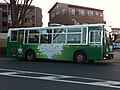
Aeromidi MK for the Hoya route
(Seibu bus possession) -

リエッセ for the Oizumi route
(Seibu bus possession) -

Poncho for Seki-cho route, the Minamioizumi route
※The image is Hoya route
(Seibu bus possession) -
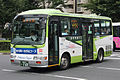
リエッセ for the Kitamachi route
(Kokusai Kogyo possession) -

Poncho for the Hikawadai route
(Kokusai Kogyo possession) -

The Seibu bus which is in the Hoya route in pinch runners usually steps space runner RM non of painting it
Vehicle before the green bus unification
-

Space runner RM for the Nerima-ku shuttle bus (existing Hoya route)
(Seibu bus possession) -

リエッセ for the Nerima-ku welfare community bus (existing Oizumi route)
(Seibu bus possession) -

Poncho (the simple painting) for the Nerima-ku welfare community bus (existing Oizumi route)
(Seibu bus possession) -
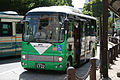
Poncho for the Nerima-ku welfare community bus (existing Hikawadai route)
(Kokusai Kogyo possession)
Abolition route
The old Nerima-ku shuttle bus was past, and, other than Hoya - Hikarigaoka Line (existing Hoya route), the route of the Seki-cho - Nerima-ku government office route [Seki branch office - Kami-Shakujii Station - Nerima-ku government office entrance] existed, but was abolished taking advantage of the Shinjuku opening of business of Toei No.12 Line on December 19, 1997. It was not the route which ran side by side with a subway, but did it with substitute routing through nearest subway Station or existing route bus and Seibu Shinjuku Line Nakai Station because there was it for inhabitant of a ward public information saying "come to the ward offices in using a subway". Since the opening to traffic of 1991, the availability improved at the pace about 10% a year, and the annual user of 1995 reached approximately 20,000 people. However, there was few it, and there was the aspect that was hard to say to have been convenient with 4 coming and going for 8 round-trip service of the Hoya - Hikarigaoka Line a day to connect it to plural railroad stations, and to use it for commuting attending school. An original service purpose and the resources review of the ward that were specialized in the setting as the foot to the public accommodation in the ward, and were operated were connected to a cause of the abolition [7].
Footnote
- It is October 4, 2013 about ^ green bus [Hoya route] platform change and a bus stop new establishment
- ^ Nerima-ku assembly - [March 1, 2012 budget special committee -03 01 days a month -11]
- - March 11, 2011 when I change part of service route of the ^ green bus
- ^ public transport blank area improvement plan (PDF) - In March, 2009, it is Nerima-ku
- ^ "Nerima-ku green bus, "Minamioizumi route" extension Tokyo". MSN Sankei news (March 16, 2013). March 17, 2013 reading.
- ^ "starts the extension service of the green bus Minamioizumi route!". Nerima-ku (March 11, 2013). March 17, 2013 reading.
- Including ^ "Nerima ward office bulletin" more
Allied item

Outside link

This article is taken from the Japanese Wikipedia Green bus
This article is distributed by cc-by-sa or GFDL license in accordance with the provisions of Wikipedia.
In addition, Tranpedia is simply not responsible for any show is only by translating the writings of foreign licenses that are compatible with CC-BY-SA license information.
0 개의 댓글:
댓글 쓰기