Helen (satellite)
| Helen | |
|---|---|
 | |
| Temporary mark, another name | Temporary mark S/1980 S 6 Another name Saturn XII Dione B |
| Discovery | |
| Discovery day | 1980March 1 |
| Detector | P, ラキューズ, J レカシュー |
| An orbital element and property | |
| Orbit semimajor axis (a) | 377,396km |
| Eccentricity (e) | 0.0022 |
| Revolution period (P) | 2.736915 days |
| Orbit angle of inclination (i) | 0.199 degrees (for the Saturn equator) |
| Satellite of the Saturn | |
| Physical property | |
| Diameter | 36*32*30km |
| Radius | 16km |
| Rotation period | 2.736915 days (synchronously rotate) |
| Albedo (albedo) | 1.67 +-0.20 |
| Equator angle of inclination | 0 |
| Atmospheric pressure | 0 kPa |
| ■Project ■ Template | |
Helen (Helene) is one of the satellites of the Saturn. In 1980, I was discovered by the observation from ピク デュ midi astronomical observatory by Pierre ラキューズ and Jean レカシュー. I was named for beautiful woman Helen who appeared in the Greek myth in 1988.
She shares revolution orbit with Dione, ポリデウケス, and Helen is located in the Lagrangian point (L4) of Dione (in addition, ポリデウケス is L5). Therefore I was called Dione B before I was named Helen formally.
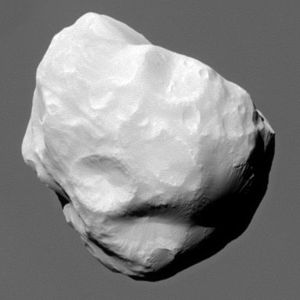
I succeeded in the photography of the image in spite of being indistinctness by Voyager 2 in August, 1981, but Cassini accessed Helen to 19,000km on March 3, 2010 and photographed a clear image. From the image which Cassini photographed so far, as for Helen, what is halved with a smooth part by a part covered in a small crater becomes clear (cf. outside link).
Outside link
- Helene has two faces - The Planetary Society: Helene Mini Atlas - Mar. 11, 2010

This article is taken from the Japanese Wikipedia Helen (satellite)
This article is distributed by cc-by-sa or GFDL license in accordance with the provisions of Wikipedia.
In addition, Tranpedia is simply not responsible for any show is only by translating the writings of foreign licenses that are compatible with CC-BY-SA license information.
0 개의 댓글:
댓글 쓰기