Japanese National Railways Taki 16200 form freight train
| Japanese National Railways Taki 16200 form freight train | |
|---|---|
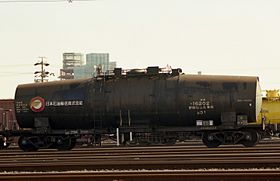 Taki 16200 form, Taki 16202 On January 16, 1994, it is Donggang Station | |
| Basic information | |
| Factory | Fuji Heavy Industries, Hitachi, Ltd. |
| The production year | 1969 (1969) |
| The number of the production | Ten cars |
| Extinction | 1999 (1999) |
| Reserve station | Nakajo Station、Nagoya south port Station、Takefu StationOthers |
| Main specifications | |
| Body color | Black |
| Exclusive classification | Vinyl acetate |
| Formation product class number | 燃 31 |
| Gauge of a track | 1,067mm |
| Full length | 12,300mm |
| Overall width | 2,720mm |
| Overall height | 3,836mm |
| Tank materials | Stainless steel |
| Load | 35 t |
| Effective cubic capacity | 38.0 m3 |
| Self-respect | 16.9 t |
| Conversion dual number product car | 5.0 |
| A conversion dual number is empty | 1.8 |
| Cart | TR41C, TR41E-12 |
| Wheelbase | 8,500mm |
| The maximum speed | 75 km/h |
A Japanese National Railways Taki 16200 form freight train (こくてつ Taki 16200 がたかしゃ) is ever Japanese National Railways (Japanese National Railways) and a private wagon registered at Japan Freight Railway Co. (JR freight) after Japanese National Railways division and privatization of April (1987) in 1987 (tank car).
Table of contents
Summary
I took these procedures as a 35t product tank car for exclusive use of the vinyl acetate in (1975) in 1975 from (1969) in 1969, and ten 6 lot (Taki 16200 - Taki 16209) was produced in Fuji Heavy Industries, two companies of Hitachi, Ltd.
The owner was Naigai Yuso, Japan Oil Transportation, three companies of Shin-Etsu Chemical.
A class number formation product "燃 31" (combustible material, flammable liquid, risk degree 2 (inside)) was marked (1979) from October in 1979.
The tank body was made of stainless steel which belonged to a 35 system type, and I comprised an urethane insulation material of thickness 75mm or 110mm, and it was covered for thermal insulation in キセ (shell).
The loading holds the cargo work method from a loading mouth in the upper dome, and discharging it is a liquid entrance and exit pipe and an Uede way type by the air pressurization. Depending on a vehicle, I equipped both pipes with a sigmoid pipe.
The body color was black, and, as for the dimensions relations, as for the full length, as for 12,300mm, the overall width, as for 2,720mm, the overall height, as for 3,836mm, the wheelbase, as for 8,500mm, the self-respect, as for 16.9t, the conversion dual number, product car 5.0, empty 1.8, cart were ベッテンドルフ-type TR41C or TR41E-12.
All cars were succeeded to at the time of the Japanese National Railways division and privatization of April (1987) in 1987 by JR freight, but seven cars registered at till the last in (1999) in 1999 became the junk car, and it was form extinction at the same time.
several production according to the year
A manufacturer and a dual number, owners by each year are as follows.
- -5 1969
- Fuji Heavy Industries two Naigai Yuso (Taki 16200 - Taki 16201)
- Hitachi, Ltd. three Japan Oil Transportation (Taki 16202 - Taki 16204)
- -1 1971
- Fuji Heavy Industries one Naigai Yuso (Taki 16205)
- -2 1972
- Fuji Heavy Industries one Naigai Yuso (Taki 16206)
- Fuji Heavy Industries one Naigai Yuso (Taki 16207)
- -2 1974
- Fuji Heavy Industries two Shin-Etsu Chemical (Taki 16208 - Taki 16209)
References
- For Shinpei Yoshioka "private wagon illustrated book (the reproduction enlargement) of professor Yoshioka" 2,008 years, it is cat publishing ISBN 978-4-7770-0583-3
- "Japanese freight train - technique history -" (freight train technology history editing Committee compilation, corporate judicial person Japan railroad vehicle industry society, 2008)
Allied item
This article is taken from the Japanese Wikipedia Japanese National Railways Taki 16200 form freight train
This article is distributed by cc-by-sa or GFDL license in accordance with the provisions of Wikipedia.
In addition, Tranpedia is simply not responsible for any show is only by translating the writings of foreign licenses that are compatible with CC-BY-SA license information.
0 개의 댓글:
댓글 쓰기