Decarboxylation
The decarboxylation (だつたんさん, Decarboxylation) is one of the forms of the organic reaction and points to the reaction that carbon dioxide (CO2) falls from a compound having carboxyl group (-COOH).

Biochemistry
An amino acid causes decarboxylation in the biosynthetic process and gives amine. General things include phenylalanine → phenethylamine, tyrosine → tyramine, histidine → histamine, serine → ethanolamine, glutaminic acid → gamma-aminobutyric acid (GABA), lysine → cadaverine, arginine → アグマチン, ornithine → putrescine, 5-hydroxytryptophan → serotonin, L-DOPA → dopamine. The decarboxylation included in the citric acid cycle has pyruvate → acetyl CoA, oxalosuccinic acid → ketoglutaric acid → succinyl CoA. The enzyme catalyzing decarboxylation is called a decarboxylation enzyme (decarboxylase) or carboxy lyase (EC 4.1.1).
Organic chemistry
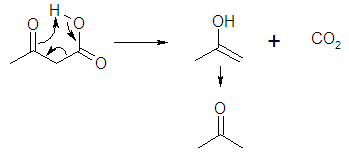
In many cases, the decarboxylation in the chemical synthesis needs the intense heating in the solvent of the high boiling point. Copper salt may be used catalytically. 2-cyclohexen-1-one has a report to catalyze the decarboxylation of the amino acid. The β-keto acid causes decarboxylation easily (lower expression), but this is because I pass through an annular transition state, and this is applied to Knoevenagel condensation, acetoacetic ester synthesis. The Burton decarboxylation is a radical reaction.
This article is taken from the Japanese Wikipedia Decarboxylation
This article is distributed by cc-by-sa or GFDL license in accordance with the provisions of Wikipedia.
In addition, Tranpedia is simply not responsible for any show is only by translating the writings of foreign licenses that are compatible with CC-BY-SA license information.
0 개의 댓글:
댓글 쓰기