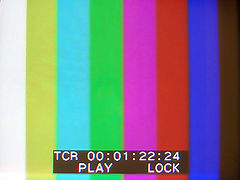
Image for the examination of the VCR for the broadcast
Terrestrial digital television transmission ARIB colorbar
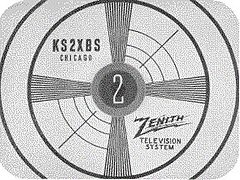
The test pattern means examination electric wave broadcast to be made in stop time of the television transmission. Colorbar and monoscope (モノスコ) are often used for the pattern signal for the examination.
Table of contents
Summary
I project test pattern ([1] that a broadcasting station name and a channel number, a call sign are often listed the picture which photographed a line reflected on top and bottom right and left mainly on the concentric circle of the bull's-eye design design radially, and the size of the pattern thing is very small) for a colorbar picture, camera adjustment called モノスコ (Monoscope) and the picture adjustment of TV on TV in stop time from middle of the night to the early morning and broadcast carrier tone (test tone of 1kHz) and record music in form to put together in it. A filler of weather camera and the CS television transmission (Nippon Television NEWS24 or TBS news bird) became often broadcasted as a substitute for test pattern after the 1990s.
In addition, until the early 2000s, the test pattern (there are 117 time signal sounds) of the NTT trunk flowed in the area except the Central Hokkaido area of Hokkaido. The test pattern of the NTT trunk did not drift after each commercial broadcasting station in Hokkaido being the whole area, and this test pattern seeing broadcast only at the time of broadcast stop after becoming it for 24 hours at the mid-2000s, and having changed a trunk to the thing of the different company before long.
The broadcast time of the test pattern was after (all or part) and (by all means) a closedown after a closedown of (noon) in the morning in the morning in time until broadcast resumption in the evening with in front of broadcast launch around 30 minutes of (noon) until broadcast was carried out all day from the television transmission dawn. It was after early-morning before broadcast launch and closedown after the broadcast launch, but I was stopping and came to often broadcast a picture and the filler picture of the weather camera all day in the after 1990s. After broadcast launch, test pattern is not broadcasted except broadcast cancellation for apparatus check overnight.
Until the end of 1970s, I was often transcribed into "test pattern" by the TV program of the newspaper, but this was because the adjustment of the television set was still necessary at home and was the part of the service for addressees. In addition, at the dawn, an electric appliance shop of the town often used the daytime test pattern for televising adjustment after the installation. In addition, the adjustment of street TV used daytime test pattern, too.
At the time of the broadcast launch, it was often broadcasted in order of "the announcements such as test pattern → broadcast launch picture (often accompanied by theme music peculiar to each station) and a call sign, frequency, the output, the telephone exchange", but there are a lot of natural exceptions. For example, the situation to attach the title of a musical composition guidance of a sound and the telop titled "a test pattern concert", and to broadcast existed. In addition, I broadcasted the performance of the district representative school of "the child eisteddfod" with an announcement introduction in Tokyo Broadcasting System (existing TBS TV) and Mainichi Broadcasting System. In Nippon Television, a jazz musical piece was used than opening of an office until the 1980s, and there was the person who checked air. I put the picture of the clock on MBS on the colorbar in Asahi Broadcasting in the early 1990s (while switching to the picture of the clock on the weather camera picture in the ABC later, and broadcasting the original piece of music of one round one minute in MBS) and broadcasted an announcement at the time.
In addition, in NET (existing Asahi National Broadcasting), a signal of 1kHz was broadcasted to a start picture with the signal of the short music box and an announcement "to broadcast test pattern for television set adjustment from now on" as whiteness five minutes ago until five minutes before broadcast launch until the 1970s. Television Kanagawa until the 1980s "whiteness → test pattern (was containing test pattern (music )→ again for long silence )→ start picture (from 9:00 to 9:01, and started with the unique format called )→ program start for from 9:01 to 9:35. Start pictures included "holiday of the dove" of Nippon Television Network and picture using the glass stick of TBS TV, picture using the illustration which I described a future city of Asahi Broadcasting in, "opening melody" (today's live performance program in the studio) of the Osaka television transmission, but each station engineering department produced these most at the time of test pattern production originally.
Broadcast immobilizes it overnight after the 21st century began (in NHK E tele and some local stations as an exception), and opportunities to see test pattern decreased, but it is early in the morning, and which broadcasting station stops broadcast for apparatus check for approximately two hours from one hour from the middle of the night and may fire test pattern during this period. When check becomes a commuter pass, I can see it on a day fixed by all means (TBS or ABC). In addition, in the Open University school, I can see it before broadcast launch every morning (ground wave, BS, SKY PerfecTV are rich).
By the terrestrial digital broadcast, ARIB colorbar may be used (ARIB colorbar may change in the diagonal direction depending on a broadcasting station).
In the test pattern of the dawn, there were the thing of the modern art-like lengthwise type (the oblong broadcast form called "イコノビジョン" was examined) that a BBC television of 1934 used in the days of examination broadcast and mere ○ and the thing which I only added one stick to below. In addition, I know that I used equipment parts of the unstable performance so that a pattern (card of the cross design) for the adjustment is inserted among programs many times using instant of the limit substitute of the scene when I look at the recording picture of the extremely mechanical TV era, and the adjustment of the apparatus which is small during the broadcast is necessary.
In addition, in about the summer of 2003 before about the autumn of 1988 and the terrestrial digital that the introduction of the clear vision (EDTV NTSC standard) was carried out began this broadcast in 3 metropolises, had been by those examination broadcast using late-night time, and have broadcasted several pieces of still images such as the expressions of a scenery photograph and the model woman of the sightseeing spot by replacement each [2]; [3]
At the time of the examination broadcast enforcement of the ^terrestrial digital, only analog broadcasted a still image, and the digital delivered a picture of the high-definition television which I photographed for digital broadcasting
In addition, Tranpedia is simply not responsible for any show is only by translating the writings of foreign licenses that are compatible with CC-BY-SA license information.
1. Searching for oil fields, development, the refinement, buying and selling, the storage of oil and the by-product and transportation 2. Various petrochemical industry 3. Atomic fuel, coal, natural gas, business other heavy electric machinery system about other oil alternative energies
Store example of the Mitsubishi Oil SS (Ageo-shi, Saitama) I am changed to the thing of ENEOS about the coloring tanker established in 1995 for the shift period to ENEOS.
Mitsubishi Oil Co., Ltd. (みつびしせきゆ) is the Japanese company which ever existed and is the oil company of the Mitsubishi group which it is one of the forerunners of the JX energy developing ENEOS of the service station in the whole country now and retained from 1931 through 1999.
Table of contents
Summary
I am established as process of the establishment by Mitsubishi joint-stock company, the Mitsubishi mining industry (existing: Mitsubishi Materials), Mitsubishi financial combine three of Mitsubishi Corporation and joint management of the associated oil. It was the first foreign capital tie-up in a Japanese oil company.
The associated oil was purchased afterwards by Getty Oil Co., but the company was purchased in 1984 by Texaco. I cooperated with Nippon Oil tied up with Caltex (Chevron as of each) which was Texaco and a joint venture of so Cal with it, and it was with the clue to the later merger.
It was the round signboard of the red three diamond, but the signboard was changed in a lengthwise rectangle of the yellow on cloth of white background in the bitter orange place until the middle stage of the 1990s to avoid confusion with the Mitsubishi Corporation oil (existing Mitsubishi Corporation energy).
It merged with Nippon Oil in 1999 and became Nisseki Mitsubishi and became extinct as a corporation (later description).
I was used until it was unified about the signboard of the bitter orange place in ENEOS in 2001 [1]. Furthermore, the company became Nippon Oil Corp. in 2002, the following day, and the name of Mitsubishi disappeared from a company name (later description).
In addition, Former President Masakichi Mizuta of Nippon Oil was in a relation of the senior younger student of the seminary with Koyata Iwasaki of the Mitsubishi joint-stock company, and Iwasaki got the consent on the Mitsubishi Oil establishment from Nippon Oil through a rice field [2].
To a thing based on "orange to shine in a blue sky clearly" by the coloring of - gas station in December a change (but full-scale development consisted of the influence of the first oil crisis that occurred just before that postponement, and the minor change of the design is performed around the end of the 1980s) [3]
I cooperate with - Nippon Oil (1984) on November 30 in 1984.
I change the coloring of - gas station to a thing based on a combination of young green and bright yellow (1995) in March in 1995 [4]
Mitsubishi Oil merges - Nippon Oil (1999) as a surviving company on April 1 in 1999, and Nippon Oil is changed a business name of to Nisseki Mitsubishi Co., Ltd. Mitsubishi Oil becomes extinct as a corporation.
- Nisseki Mitsubishi changes a business name of it to NIPPON OIL CORPORATION (2002) on June 27 in 2002, and the name of Mitsubishi disappears.
Ad
I show it about a television commercial performer of old Mitsubishi Oil Era and a sponsor program here.
For 1:00 period of the 1960s, I support it by two joint crown offers with Mitsubishi Corporation as well as the above as dusk day game held (the doubleheader of dusk, the night game was frequent) "Mitsubishi diamond night game" on Sunday
The round signboard of the cloth of white background was left in spite of being a few after the ^ Nisseki Mitsubishi start. In addition, a large number of signboards continued after a merger as "Mitsubishi Oil".
It is open with ENEOS brand at the present that is the reincarnation company of ネクステージ - us (existing JX energy) and the joint venture of the Mitsubishi Corporation oil (existing Mitsubishi Corporation energy) (like in the capital structure top in the existing corporation).
In addition, Tranpedia is simply not responsible for any show is only by translating the writings of foreign licenses that are compatible with CC-BY-SA license information.
It is indicated that the old legend connects ヘルクラネウム with Greek hero Hercules, and a town was built by a Greek [1]. The ancestors of the Italian Samnite seemed to build the civilization in this place first at the about the end of sixth century B.C. I did it soon, and the town was in the Greek follower afterwards. The Greek named a town ヘルクラネウム and the Gulf of Naples might be near and used a town as a trade base. A Samnite ruled over ヘルクラネウム again in the fourth century B.C. and continued until the rule was defeated by aide ティトゥス dede Usu of general スッラ in alliance City war (war of the allied force for Rome) that ヘルクラネウム participated in, and it was in ムニキピウム of Rome in B.C. 89.
After the eruption of the Mt. Vesuvius volcano of 79, lava and soil and ash have covered the town of ヘルクラネウム with the thickness approximately 20 meters. The town slept with the approximately same figure afterwards in the underground more than 1,600 years until I was discovered in the worker who dug the well in 1709 accidentally. Excavation work was pushed forward since discovery, but is not still finished. Current エルコラーノ and ポルティチ are almost located in the place where there was ヘルクラネウム. The town of エルコラーノ was called レシーナ until 1969, but was changed the name in エルコラーノ which made ヘルクラネウム modern Italian in commemoration of an ancient town.
It was Hercules told to have created town and the Mt. Vesuvius volcano to have collected the faith of inhabitants most. Important God believed in elsewhere is lover of Hercules and believed Venus and Apollo.
The plural cities around the Mt. Vesuvius volcano including ヘルクラネウム were damaged by eruption. The black cloud expresses ash and the rough distribution of the descent of the cinder.
Eruption of 79
The eruption of the crushing Mt. Vesuvius volcano happened on the afternoon of August 24, 79. It was thought that the Mt. Vesuvius volcano stopped activity for approximately 300 years, and it was not recognized that it was a volcano generally anymore, but some intellectuals recognized that Mt. Vesuvius erupted in so far-off old days [2].
I can follow progress of the eruption by two letters which archeological excavation and small プリニウス addressed to historian Tacitus.
Ash and a cinder blew up from the Mt. Vesuvius volcano to several thousand meters of sky at about 1:00 on the afternoon of August 27. プリニウス describes the form that the upper part of the smoke when ejectamenta arrived at it between the troposphere and the stratosphere levelled out with Kasamatsu (English version). Because the wind blew to southeast, the ejection dropped mainly in Pompeii and the area of the rotation. Because ヘルクラネウム was to the west of the Mt. Vesuvius volcano, I did not suffer damage too much at the first stage of the eruption. Ash was piled up several centimeters in ヘルクラネウム, but most of inhabitants ran away at this stage whereas a roof of houses of Pompeii was destroyed by heaviness of the ejectamenta which fell.
It has been thought that almost all inhabitants barely evacuated because only a few human bones were discovered by early excavation for a long time. When excavation extended to the area of the boathouse of the shore in 1982, this opinion was changed. Archeologists discovered a human bone of 250 to gather around to be close together leaning on each other in 12 boathouses.
The boathouse where a human bone was discovered
During night, 達 っしていた ejection has begun to drop with the figure such as the pillar in Mt. Vesuvius in the stratosphere. Pyroclastic flow occurred and gas, ash, a stone of 400 degrees Celsius mingled and surged against ヘルクラネウム at 160km per an hour. The pyroclastic flow arrived at the boathouse at about 1:00 a.m., and the people who were waiting for help there lost a life by intense heat instantly. Because an ejection gradually covered the building by pyroclastic flow of this time and pyroclastic flow of subsequent several degrees from the bottom, the building was not greatly damaged.
According to the following factors, it seems that a building and matter of the inside were preserved in a very good state.
Because a building had been already buried among 火砕物 before wind changed, and ash descended in ヘルクラネウム, a roof was not destroyed.
Heat of the first pyroclastic flow was carbonized at the organic surface and removed water.
The tufa which had high density cut off ヘルクラネウム from air thick (I reach 25 meters) for 1,700 years.
Excavation
The excavation was begun at a place of current エルコラーノ in 1738. Though detailed publication Le Antichita di Ercolano (remains of ヘルクラネウム) by the support of both Shichi King Lear was a limited circulation, I had a very big influence on the European neoclassicism that began at that time. The motif of the design found in the furniture such as a tripod table, an incense lamp, the teacup from a decorative fresco in ヘルクラネウム appeared at the end of the 18th century. However, the excavation was stopped when a town of Pompeii nearby was discovered. Because Pompeii was approximately 4 meters whereas sediment overturned on the thickness of 20 meters, excavation was much easier for ヘルクラネウム. It is the 20th century, and excavation was reopened, but the personal and public building including the compound facilities of the plaza is non-excavation.
Human bone
The pyroclastic flow took the life of the inhabitants who failed to get out in time immediately. The figure of the people who lost a life in ヘルクラネウム was not stored with gypsum unlike Pompeii.
When the worker of the public works project of supervisor Italy of the Dr. ジュセッペ Magus dug the drainage in ヘルクラネウム in 1981, I discovered ashes. It was pressed Dr. Magus, and the Italian government official invited Sarah C Beissel of the physical anthropologist for conduct of the excavation and the study of ashes from the United States. This investigation was served by a fund of association of National Geographic.
There were few Roman bones which I could use for a scientific study until this discovery because the ancient Roman usually cremated it. By the excavation of the port area of ヘルクラネウム, human bones (adult male 30, adult woman 13, child 12) more than 55 were discovered. The human bone was found by the sea. It is thought that they were going to escape from eruption from there. The woman (Ring Lady) of the ring named by the ring which I attached to the finger is included in this human bone.
The Dr. Beissel was able to get deep knowledge about health and the nourishment state of inhabitants of ヘルクラネウム by the chemical analysis of these remains. There was the thing that highly-concentrated lead was detected in the ashes, and lead poisoning was doubted [3]. New knowledge was provided by the analysis of the bone. For example, I was able to suppose the number of children whom a woman had by a pelvic scar.
Problem of the preservation
The water, the ash, the cinder which covered ヘルクラネウム played a role to save remains in a very good state with the great high temperature that attacked it at first for 1,600 years. However, the remains which were exposed to the atmosphere when excavation began have begun to go bad gently. This was unavoidable by the technique of the archeology that it was original and had stolen of the excavation of the town to establish the principal objective in obtaining valuable remains than the preservation of all the remains at the time. The preservation of ashes became the priority by instructions of the Dr. Sarah C Beissel in the early 1980s. When the carbonized remains were exposed to air, organic matter deteriorated during a few days. Therefore, many remains were lost before the preservation method was established.
The damage is taking place with most of the area shown by sightseeing and intentional destruction today. In addition, it is eroded foundations of many buildings part by water flowing from the town of current エルコラーノ. The trial of the rebuilding often became the opposite effect, but the effort of the recent preservation achieves an effect. The excavation work is stopped once now to appropriate a budget to the preservation of the town.
A large number of remains excavated in ヘルクラネウム are kept by Naples, Kunitachi archeology Museum.
ネプトゥーヌス and the house (the 22nd house) of Amphitrite are famous in トリクリニウム (dining room) and ニンファエウム (haikal given to a nymph) for the wonderful summer given glory with a mosaic.
The mosaic which was drawn on ネプトゥーヌス and Amphitrite, the wall of the 22nd house
A novel of the setting that super huge eruption happens in Japan by "city in ruins Japan" - 石黒耀. A dire disaster to be exterminated is described in the pyroclastic flow which the people who were waiting for a ship fell down from the Mt. Vesuvius volcano in order to get away from ヘルクラネウム by the prologue.
References
For Shiro Kaneko "day Orient place abounding in books when Pompeii died out", 2,001 years, it is ISBN 978-4,887,214,972
National Geographic, Vol 162, No 6. Buried Roman Town Give Its Dead, (December, 1982) which improves
National Geographic, Vol 165, No 5. The Dead Do Tell Tales, (May, 1984)
Discover, magazine, Vol 5, No 10. The Bone Lady (October, 1984)
The Mayo Alumnus, Vol 19, No2. An Archaeologist's Preliminary Report: Time Warp at Herculaneum, (April, 1983)
Carnegie Mellon Magazine, Vol 4, No 2. Bone Lady Reconstructs People at Herculaneum, Winter, 1985
In the Shadow of Vesuvius National Geographic Special, (February 11, 1987)
30 years of National Geographic Special, (January 25, 1995)
Link
Wiki media Commons has the media in conjunction with ヘルクラネウム.
In addition, Tranpedia is simply not responsible for any show is only by translating the writings of foreign licenses that are compatible with CC-BY-SA license information.
The Control Data corporation (CDC) was the computer company which was famous as a pioneer of the super computer.Seymour Cray belonged through the 1960s and continued making the fastest computer. However, clay left the company in the 1970s and founded Cray Research (CRI) and took the world fastest title. CDC was one of nine major computer manufacturers of the 1960s (as for the others IBM, Burroughs, DEC, NCR, GE, Honeywell, RCA, UNIVAC).
Table of contents
A background and the origin: I am until 1957 by World War II
During World War II, I let the development of the machine which decoded the code that U.S. Navy gathered engineers, and was made with the Japanese military and mechanical code making device of the both German forces hit it. A team collected in Washington D.C. created that kind of machines. The navy felt uneasy about a security leak when I broke up this team in postwar war expenditures reduction and has begun to look for a method not to break it up.
And a solution was found at last. I was settled by having the company called Chase Aircraft of Minnesota Saint Paul take over engineers. The company lost most of the contracts with the military with the end of the war and was in trouble. Therefore I spoke it without explaining what a team was doing just I of I was saved very much for the military if I employed merely them. I doubted it at first, but the officer of the naval higher position came to come at every meeting and understood an earnest thing. The company agreed that the team was based in the military glider factory after all.
Engineering Research Associates (ERA) was established and at a glance in this way engaged in unrelated various projects until the early 1950s. One of those is world's first commercial stored program computer, ERA 1103 of 36 bits. This machine was developed for the navy and was intended to use it in decryption center. It was considered to be a problem that the navy performed "possession" of ERA substantially in the Diet in the early 1950s. As a result, in ERA, relations with the navy were quitted (including the raise in fund), and the owner of ERA sold a company to Remington Landes Corporation in 1952.
Remington Landes Corporation maintained a team of ERA and continued developing the new product. It is magnetic drum memory system of ERA that the company was interested most. It merged with Sperry soon, and the Remington land was Sperry rand, and the ERA section was absorbed in the UNIVAC section of Sperry. Technical talent was bought, and the people who came at first from ERA participated in various projects. However, the UNIVAC II (English version) project left to ERA by UNIVAC was late for a delay, and was concerned; all approximately let condition be out of order.
The company's custom of the big company resigns as 合 trap and engineers of ERA which I felt and establishes Control Data in Minneapolis in 1957. The CDC establishment member picked William Norris to a chief executive officer with one accord. In addition, Seymour Cray was chosen as a chief designer, but was not able to join CDC because work about 1103-based navy tactics information system (NTDS) continued until it was completed.
An early design: Great plan of the clay
Because CDC sold the subsystems such as magnetic drum memory systems mainly, I started business. When clay joined in the next year, I developed transistor-based 6 bits small size machine "Little Character" immediately. This was a test for the ideas of the large transistor base machine which Cray thought about.
Little Charactor gained success, and, in 1959, they released CDC 1604 (English version) for the transistor which made 1103 48 bits. The first finished product of CDC 1604 was delivered to U.S. Navy in 1960. With the opinion which added address (501 Park Avenue) of the first location of CDC to "1103" which Cray still developed as for the number called "1604" before [1].
Console of the CDC 3000 series
CDC 160A (English version) that scales it to 12 bits, and fell is released in 1960. This is often considered to be the world's first minicomputer. 160A was a shape of the standard office desk and was the design which was rare for those days. In addition, the new version CDC 3000 (English version) series of 1604 architecture will be sold until the mid-1960s.
The clay started the design of the machine of the world's best performance. The aim is performance 50 times as large as 1604. To that end, it was required was bold, changing it, and a project took time (it takes four years really). The administration began to mind the trend of the project, and Cray offered own research institute establishment in 1962 because an eye of the monitoring became severe and said it when I resigned if not admitted. Norris consented to this, and the clay took a team. In the administration of CDC which included Norris, a promise not to be able to visit the research institute of the clay is exchanged unless I am invited [2].
Peripheral device business
Through the 1960s, I came to feel that Norris had to develop something serious to be opposed to IBM. Therefore I started a bold strategy that he purchased the peripheral device company and prepared a lineup. They set a 10% price cheaply from IBM and tried that I provided a 10% high-performance thing. This was not always easy.
One of the first peripheral devices has a magnetic tape unit. I wrote the peripheral device section to let the section share cost in this development other than an office, and a slight discussion occurred. The peripheral device section is without a method to profit if it supplies an apparatus to other sections with the price of cost price equivalency. The peripheral device section was settled instead by having you return a part of the profit when a peripheral device sold, and the afterward method settled.
A card reader, card punch, a tape drive (strike reamer), the thing of the all company design including the drum-type printer were developed afterwards. As for the printer business, a Chinese holly carburetor in the suburbs of Detroit produced facts at first, but establishes a joint venture later. Furthermore, the Chinese holly sold a possession stock to CDC and was admitted into CDC as a printer section.
Norris explored the input means for the punched card which IBM influenced. He decided to purchase Rainbow Engineering Corporation which was the pioneer of the optical character recognition (OCR) system. The idea was a thing to dispense with a punched card by reading the thing which I devoted myself to with the typewriter of the font that an operator was decided on commonly in OCR. A large quantity of information is included farther than one piece of punched card in one piece of typed page (the punched card has only one ぶんの information of the type basically). Therefore, it is saved the paper. However, this was the switch that was difficult than I thought. CDC performed an important role by an early OCR system, but OCR has not become the main data entry means to this day. The factory of Rainbow performed a shutdown in 1976, and CDC stopped the business, too.
When it was revealed that a punched card did not disappear immediately without progressing as an OCR project thought, it was approached by the need that CDC coped with this immediately. The punched card apparatus continued being made, but they had high cost price. Therefore I will purchase Bridge Engineering company having the apparatus which is cheaper, and is high-speed. The magnetic tape unit came to prepare it in the factory, too. It was made a spin-off, and the factory and the factory of the printer became joint venture Computer Peripherals Inc with NCR (CPI) later. This reduces cost by commonizing development; had a meaning. Furthermore, this increases ICL later, too. Furthermore, in 1982, a printer factory was sold to Centronics from there.
Norris presented the office which provided calculation service for the medium and small-sized business which could not purchase a computer in many places. This business did not produce much profit. I suggested to Norris that some managerial classes closed the office which was not released of the profit in about 1965. However, I ordered general economy instead without accepting the suggestion because Norris liked this idea.
It is the birth of the super computer CDC 6600
CDC 6600
On the other hand, Seymour Cray and 34 engineers continued a design at a new research institute. In 1964, the result was released as CDC 6600 and was proud of performance more than 10 times in comparison with every machine which there was in the market. 6600 CPU's were comprised of the functional unit which was plural async and ten I/O processor was connected and took charge of the general task load of most. Therefore the CPU leaves common work such as a Hollerith card and the disk input and output to a controller and can devote myself to data handling. I recorded performance of about 1MFLOPS with the latest compiler when I wrote a code with an assembler performance of 0.5MFLOPS. It is the number that is wonderful when this thinks about the times. Version CDC 6400 and 2 processor version 6500 that cut down on performance were released.
When 6600 was shipped, IBM paid attention to this new company. When the Thomas J Watson youth said, "I did what defeated our company where the small company where there are only 34 people holds several thousand even if I let this gate-keeper how", I am informed it. It is said that Cray which heard this said that it is, "there is an answer in the question". In 1965, IBM started a development project of high-speed machine ACS-1 (English version) at 6600. 200 people were gathered for this project. This project produced the interesting architecture and techniques, but it was incompatible with System/360 of IBM. A turn was planned to become the System/360 compatibility, but therefore performance lowered, and the project was canceled in 1969 without being able to bring about any product. Therefore many engineers concerned with this resigned from IBM, and a brain was lost by the high-performance computer section of IBM.
On the other hand, IBM jumped ahead and announced new version Model 92 of the System/360 series of the performance equal to 6600. This machine did not exist, but did not cancel it until people waited for the release, and 6600 sales stopped (marketing technique named FUD today). Norris did not leave this lie and accused IBM of violation of antitrust law one year later. CDC obtained assets of IBM of the 80 million dollars equivalency after all [4]. Norris paid attention to Service Bureau Corporation (SBC) in that. The company owned a computer and offered computing power to other companies. This fitted in into the calculation service business that Norris pushed forward well [5].
In the process of 6600 designs, CDC carried out an SPIN project to provide a high-speed magnetic disk unit system in the system. It was unknown whether a magnetic disk replaced magnetic drum memory, and it was unknown which of a fixed model and the removable model was good for the disk in those days. Therefore I tested every choice by the SPIN project and finally brought about 28 inches of fixed disks type and pack type of 14 inches. Hard disk business started from an SPIN project becomes the main force of CDC afterwards.
CDC 7600 and 8600
In a month same as what won against IBM, CDC announced new machine CDC 7600. I assume clock frequency 6600 approximately 4 times (10MHz ⇒ 36MHz) and realize throughput more than 4 times as the whole system.
It is the adoption of the instruction pipe line and does the decisive factor of the performance enhancement when it can process at the same time plural orders because the all parts in the CPU process an order in sequence each. Therefore, as a whole, throughput improves, and the execute time of the program is shortened even if the processing time of 1 order is the same.
Because 1,969 years when 7600 came up were the economic recession period of the United States, the reaction in the market was not sweet. In addition, I produced a problem in reliability because it was a too complicated design. I included only the function that was incompatible, and most of the OS's were made newly and was basic that was complete with 6000 series. 7600 projects got the profit somehow, but it followed that I lost reputation of CDC.
The clay started CDC 8600. 8600 classified 7600 into four, a smaller housing basically. 8600 could work in higher clock frequency by reducing size, and shortening a signal path and should have improved performance in high-speed memory and the thing that I put together. However, 8600 took a manufacturing method from before. In other words, I soldered parts on a board. Because there were too many soldering points, the machine did not work even if one place became poor in contact and, as a result, never worked properly. If the fresh start of the design was necessary, I decided the clay.
STAR and Cyber
In addition to 8600 re-designs, CDC had a project called STAR. Gym Sohnton who worked with clay in 6600/6700 led STAR. The design of STAR processes only a mathematical operation by a pipeline having a long it very with a thing using the technique called a vector processor now. The mathematical operation was full of it and was speeded up, but was in this way later than 7600 other than it. Because it was rapidity of the mathematical operations that a customer of real CDC demanded, it was not considered to be the big problem. The vector of STAR had 65,536 length by 64 bits width.
1960s end game, CDC did not have the financial power as they let these two projects go at the same time. I talk with Cray about Norris, and the clay establishes Cray Research in 1972. Norris continued helping Cray afterwards. 8600 was canceled in 1974, and STAR was released as Cyber 203 in the same year. However, STAR was not able to give performance by the real user's program at all. Gym Sohnton leaves CDC and will found Network Systems Corporation.
CDC packages it on the basis of the 6600/7600 architecture again and sells it as the CDC Cyber (English version) series. This was the main product of the 1970s of CDC. Hash-up version Cyber 205 of STAR was cast into the Cyber series, too, and this was high-performance unlike an original as such. However, Cray gave the machine which the technique of STAR such as Cray-1 took in at that time, and a computing performance was extremely high.
Cyber 200/205 which CDC released was performance to be able to fight against Cray Corporation on equal terms in the specific field. CDC participates in various projects of the customer and participates in project black project of the military. One of the result includes Cyberplus by CDC Advanced Flexible Processor (AFP) another name.
Directionality of another design includes "Cyber 80 "project. This can execute 6600 programs, but the architecture is totally new 64 bits. I aimed at the release of 1980. This expected the replacement by purchase of the user of 6000 series. The project delayed and was finally released in the different name.
PLATO terminal (1981)
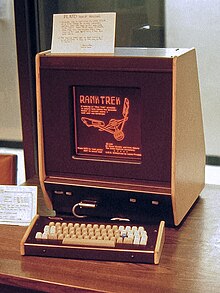
In addition, I planned the switches from hardware dependence to a service-centered business form. For example, there is development of learning system PLATO using the computer. I worked on Cyber system and adopted the latest user interface including the terminal with the touch screen of the BitMap method.
I it to ETA systems, a hard disk and the distance of the oblivion
CDC was going to challenge performance again. However, I thought that Norris became stiffening too much as an organization to create the designs that CDC had good quickly. Therefore he established new spin-off company ETA systems in 1983. The design target of the ETA is performance 40 times as large as 10GFLOPS, Cray-1. The ETA was not able to achieve an aim, but I had laurels of the world's best performance in my hand temporarily, and there were the some sales in the next year, too. CDC thought about making up for a loss by selling ETA, but I discharged most employees in 1989, and the employee who remained employed it again in CDC.
On the other hand, a big company such as Japanese NEC and Fujitsu has begun to enter the market. The super computer market is not so big. CDC looked for other markets. It is a high-performance hard disk market to have found. At the mid-1980s, a hard disk began to be equipped with by a personal computer and was a promising market. CDC occupied the seat of the top by OEM from the 1970s through the early 1980s in the market of 14 inches of disk drives. I go into 8 inches of disk drive markets which シュガートアソシエイツ cut open quickly. I came to occupy a big position in a particularly high-performance hard disk. However, it is large-capacity, and a technological advance advances by the entry of the new company rapidly, and CDC comes to fall behind it. It is CDC to have developed ATA standard with Compaq and western digital.
Curiously CDC let a hard disk section make a spin-off in 1988 and had the company called Imprimis. The Seagate technology that demanded the clue to the high-end market in the next year purchases Imprimis. CDCのコンピュータ部門はコントロール・データ・システムズと改称、BTグループの傘下に入り、BTのグローバルサービス部門に吸収された。
「訴訟を取り下げる見返りとして、CDCは多くのものを勝ち取った。約1600万ドルでIBMの Service Bureau Corp. を獲得。同社は所有するコンピュータのCPU時間を顧客に売ってデータ処理を行うサービスを提供している。ウォール街のアナリストは、同社の市場価値を約6000万ドルと見積もっている。さらにIBMは同社から5年間サービスを購入し、6年間は同様のサービスを立ち上げないことで、CDCが費やした弁護士費用1500万ドルを相殺するという。したがってIBMが支払う総額は少なくとも8000万ドルとなる。CDCのワンマン会長ウィリアム・ノリスは、大胆な訴訟が「我が社の歴史上最善の経営判断の1つになった」と語った」
Lundstrom, David. A Few Good Men from Univac. Cambridge, Massachusetts: MIT Press, 1987. ISBN 0262121204.
Murray, Charles, and John Wiley. The Supermen: The Story of Seymour Cray and the Technical Wizards behind the Supercomputer. New York: John Wiley, 1997. ISBN 0471048852.
Price, Robert M. The Eye for Innovation: Recognizing Possibilities and Managing the Creative Enterprise. New Haven, Connecticut: Yale University Press, 2005. ISBN 030010877X.
Worthy, James C. William C. Norris: Portrait of a Maverick. Ballinger Pub Co., May 1987. ISBN 978-0887300875
In addition, Tranpedia is simply not responsible for any show is only by translating the writings of foreign licenses that are compatible with CC-BY-SA license information.



![[icon]](https://upload.wikimedia.org/wikipedia/commons/thumb/1/1c/Wiki_letter_w_cropped.svg/20px-Wiki_letter_w_cropped.svg.png)