When I run the train of the railroad, train resistance (れっしゃていこう) is resistance for the progress [source 1]. The thing which falls down, and added up all the resistance by some factors including the resistance of air resistance and the wheel is train resistance.
Table of contents
Element of the train resistance
The train resistance is comprised of some elements. I show below an element.
Starting resistance
Run resistance
Incline resistance
Curve resistance
Tunnel resistance
It is big and I am caused by necessary thing (starting resistance, run resistance), facilities physically to let a train accelerate and am classified in (incline resistance, curve resistance, tunnel resistance). In addition, you must turn the rotary parts of a wheel and the motor fast to accelerate, but this must let you accelerate rotary motion separately from acceleration of the going straight exercise as the whole train, and there is resistance in this. I may call this power acceleration resistance, acceleration resistance, an inertia coefficient.
The train resistance may measure power to act in a real vehicle by Newton unit, but expresses it in many cases in power (N/t) per train 1 ton in weight. I explain train resistance per this train 1 ton in weight in the following.
Starting resistance
By the resistance that acts when a train departs as for the starting resistance and begins to work, I am caused by the friction of an axle and the bearing. I may call it start resistance. Because the moment when it begins to work is the biggest and becomes small rapidly when speed rises, I usually bind a value at the age of 0km/h and a value at the age of 3km/h together by a straight line and express it and consider it to be run resistance after it. I express the starting resistance by power (unit N) per 1t in weight of the train.
The run resistance is caused by the friction of air resistance and a wheel, the axle by resistance to occur on a train when a train runs. The run resistance divides it into vehicle resistance and air resistance more and thinks.
Vehicle resistance
Vehicle resistance is mechanical resistance by a vehicle running. When the vehicle resistance disintegrates more finely, there is the resistance of the slide part of turn resistance, others concerned with the motors such as frictional resistance, the motor of frictional resistance (by being able to rub a flange mainly), an axle and the bearing between a wheel and the rail. The resistance of an axle and the bearing decreases around the unit weight so that pressure to depend on a bearing becomes big. In addition, vehicle resistance increases because the viscosity of the lubricant is low so that temperature is high when generally it is winter.
Air resistance
As for the air resistance, a train top part pushes air aside by a train running and occurs by receiving resistance by the train side and friction of the air. I almost grow big in proportion to square of the speed. The size of the air resistance of the lead car consists of middle vehicles approximately approximately 10 times. In addition, because air becomes thin and pulls a vehicle on end side when a train moves even a vehicle of the end, resistance grows big in comparison with middle vehicle, and it is to approximately 2.5 times. Therefore, the air resistance per unit weight decreases so that a constitution dual number of the formation becomes long. In addition, I do not affect the air resistance even if a traveler and freight are put only on anything in in only the outside shape and materials of the vehicle influencing it. In other words, the weight does not influence air resistance.
In addition, air resistance in itself increases conspicuously in the tunnel, but this illustrates by a passage of the tunnel resistance.
Expression-style of the run resistance
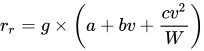
Because it is a difficult value to analyze the run resistance theoretically, I make an expression to express this for the cause and use an actual value every form of the vehicle. The general formula,である. Train mass (t), g are acceleration of gravity (m/s2) run speed (km/h), W run resistance (N/t), v rr, and a, b, c are the fixed number.
a is the clause that is unrelated to the speed with a value depending on the friction of an axle and the bearing mainly. b is a value depending on the friction of a wheel and the rail mainly, and this part is a clause in proportion to speed. Because a tare does not influence c in a clause in proportion to square of the speed with a value depending on air resistance again, I break it at weight.
The concrete run resistance calculating formula is given, for example, by a Shinkansen 100 system train with rr = g (1.273 + 0.001v + 0.0001381v2).
Incline resistance
When a train approaches the ascent, I work in the direction that the ingredient of the incline parallelism direction of the gravity stops in spite of the progress of the train by the degree of leaning of the point. This power is called incline resistance. This power can express W (t), acceleration of gravity at train weight with Wg sinθ when I assume the angle of the g (m/s2) incline θ. Using being sinθ ≒ tanθ, the incline resistance at the incline of the h par mil is expressed in Wgh by permillage (gone thick-haired codium) that is used generally to express the degree of the incline in a railroad as far as θ is small enough when I rearrange it. Incline resistance of 245 (N/t) will act at 98 (N/t), 25 soft-headed mil inclines at 10 soft-headed mil inclines. This works in the direction letting a train slow down in the ascent, but works in the direction letting, on the contrary, you accelerate a train in the downslope.
Curve resistance
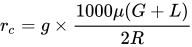
When a train runs a curve, a flange touches it, and a wheel is slippery with an outside rail to absorb that the length of the rail of the outside and the inside is different. From this, when I run a tangent, I compare it, and train resistance increases. This power is called curve resistance. Is affected by various elements, but to the publicI am given in an expression of の Morrison. In rc, in curve resistance (N/t), G, in (m), L between the gauge, as for wheelbase (m), μ of the cart, coefficient of friction, R of a wheel and the rail are curve radius (m) here.
The expression that substituted a general value by Japanese JRold line, and took the result of the examination into consideration, and simplified this,となる. K uses 800 by the JR old line with the fixed number. C is a curve radius of the point. Therefore, it becomes around 19.6N/t with 9.8N/t, the curve of 400m with the curve of a radius of 800m.
Tunnel resistance
When I run the tunnel, when I run the tunnel outside (I call it a light section), I compare it, and air resistance of the run resistance is enhanced by influence of the wind pressure. I call this increase tunnel resistance. I am influenced by values such as a shape, the speed of a cross section and the vehicle of the tunnel.
In the Shinkansen, I am 270km/h in resistance increase of around 30-50N/t when I break into the tunnel of the double track section when I run. This is degree same as an ascent of the 3-5 soft-headed mil degree. On the other hand, when an old line train breaks into the tunnel of the single line section by a 160km/h run, there is resistance increase of around 80-120N/t, and this is equivalent to the ascent of the 8-12 soft-headed mil degree.
In a real calculation, I often set expression itself of the run resistance particularly for tunnel sections. The run resistance calculating formula in the tunnel of the Shinkansen 100 system train is given with rr = g (1.273 + 0.001v + 0.0002569v2).
Use of the train resistance
The value of the train resistance makes the general formula that expressed it based on an actual value well, and what I demand by the expression is common. This ceremony is used for the making of the driving curve. The driving force (tension) of the train at a certain point in time is decided by the performance of the train and the driving of the driver. The acceleration of the train is provided by dividing the value that deducted train resistance from this driving force by the mass of the train. The driving curve adds the driving method of the driver at the point in time while calculating train resistance to change by a curve or the incline of the route at any time and is provided by calculating the speed at each point of the train. I calculate the standard driving time that is the standard time required between the station for the cause in this.
References
"Electric railroad handbook" electric railroad handbook editing Committee, CORONA PUBLISHING CO.,LTD., 2007. ISBN 978-4-339-00787-9。 pp.391 -393
Run resistance investigation subcommittee "run resistance Japan Society of Mechanical Engineers Vol.67 No. 543 (April, 1964) pp.620 -630 of the railroad carriage of the railroad carriage"
In addition, Tranpedia is simply not responsible for any show is only by translating the writings of foreign licenses that are compatible with CC-BY-SA license information.
I measure the speed of the train, and speed collation (そくどしょうさ, English: speed check) is to collate it whether the speed is within the permitted speed. It may be abbreviated to a speed check. The system is usually such that I operate brakes automatically, and slowdown stops a train when the function of the speed collation is given in automatic train security such as the ATS (automatic train control), and a train exceeds the speed limit in the instructions speed of the signal or a turnout, the curve or I am going to exceed it.
Table of contents
Summary
I check that the speed collation protects a determined speed limit, and a driver runs a train mechanically and am the structure which protects the security of the train by braking it forcibly when I am not protected.
As for the speed limit in the railroad, there are always both things which a limit changes into based on a thing of the constant speed and the current indication (現示) of the signal in terms of time like the limit of the transit rate of a turnout and the curve. It is different which type of traffic calming you cope with by the kind of the device of the speed collation.
The speed collation works by the combination of devices installed on the device and the car installed in the ground. There are various methods how you convey information on the car from the ground how a device applies a speed limit in a car. In addition, about the movement when I detected speed limit violation by speed collation, there is the thing of the method to loosen brakes when a train slowed down in thing of the method that takes an emergency brake, and stops a train on the spot and lower than speed limit.
In this item, I explain an example of various security which implemented various methods, principles and them which are used by speed collation, the setting situation.
Information transmission method
The kinds of the speed collation method are classified in two kinds of point control and consecutive control by a way of the transmission of the information from the ground to the car top.
Point control
The speed collation of the point control (intermittent control) transmits information from the ground to the car top at a particular point. Because the point that I can transmit is limited, I cannot transmit it to the car top immediately even if the instructions speed of the signal changes on the way. The device on the car performs speed collation depending on the information that I received, but there is a method (consecutive collations) that a device memorizes information in a car to a method (point collation) to perform collation of speed only at the point that received information, and to brake as needed and the point receiving speed limit information next, and collation continues doing the speed of the train.
Consecutive control
The speed collation of consecutive control (continuous control) transmits information from the ground to the car top at any time. Even if a train is at any position, I can transmit the information to the car top immediately because information is continued always transmitting when the instructions speed of the signal changed. Based on speed limit information to receive continually, the speed of the regular train is performed collation of.
Collation method
Based on the information that I received, there are point collation, consecutive collations, pattern collation for the method that how performs collation of the speed of the train.
Point collation
The point collation points at performing speed collation by the information that I received based on information transmission of the point control only on the spot. The control of the train in the meantime will be entrusted to a driver without collation being carried out any place other than the collation point to perform speed collation only at the point where information transmission was carried out.
I show the concept of the point collation in the figure. In the figure, I take speed in distance, the vertical axis direction in the cross axle direction, and the train shall move to the right from the left. I express the speed limit of the point by the light green coloration. In this example, the speed limit is 100km/h first, but a speed limit changes to 80km/h halfway. Therefore, it must slow down appropriately by a speed limit start point.
1.When I brake it like a curve blue for some time to some extent than the point where traffic calming is started and slow down as having shown に, I protect an appointed speed limit and can run. This is demanded driving.
2.Oh, it is the example which set speed collation to guarantee to run at 80km/h at the start point of the speed limit. I collate the speed of the train in pinpoint at the position that I showed in a red vertical line and brake it automatically if I cannot protect the investigation whether you protect an 80km/h limit. When a driver brakes it definitely and slows down along a blue line, I do not have any problem and clear the check of the speed collation and can progress. However, I exceed a speed limit because I cannot let lower than speed limit slow down immediately even if the brakes by the speed collation operate when I do speed collation in speed limit start point itself in this example and a driver ignores the speed limit at all and just progresses as showed in a red dashed line.
Therefore, it is necessary for the point to hang speed collation to set it forward to some extent from a speed limit start point 3 as having shown で. As for the distance of a point and the speed limit start point of the speed collation, it is decided by the brakes of the vehicle traveled by the degree and the route of the demanded slowdown. Because the train which moved in defiance of a speed limit as showed in a red dashed line slows down in lower than speed limit by a speed limit start point, the speed limit violation does not get up. On the other hand, because a point performing speed collation moves toward you, it comes to be demanded that even the train which does not have any problem, and is run protects a speed limit from the speed collation point before the speed limit start point twister and runs it, and the section of the speed limit will enlarge it toward you substantially.
4.It is the example that は driver tried speed limit violation with malice. Because they collate only speed in one spot that is the speed collation of the point collation type, the automatic brakes do not hang if they protect a speed limit only at the point. If it accelerates again after clearing a speed collation point, it is possible easily to violate a speed limit intentionally. In addition, it cannot have possibilities to slow down enough by a speed limit start point even if brakes begin to hang by speed collation when in the first place I largely exceed a limit in section assumed 100km/h restrictions and come in the speed collation point.
When I drive with malice by the point collation in this way, I cannot completely prevent excessive speed. However, in the real railroad, I can realize enough safety if I can prevent carelessness, the mistake of the driver because it is enough if collation speed and a collation point are set appropriately.
Consecutive collation
The consecutive collations point to performing regular speed collation by the speed limit information that I received based on information transmission of consecutive control mainly. But there is the method that maintains the speed limit information that I received by point control until the next information transmission, and continues doing collation.
I show the concept of consecutive collations in the figure. The viewpoint of the figure is the same as the figure of the point collation. Because collation is carried out by the consecutive collations continually, collation speed is set every section.
1.When に is identical to a speed limit as showed and sets collation speed, as for the automatic brakes by the speed collation really operating for the train which ignores the speed limit, and just progressed, it is after a speed limit start point, and, in the case of point collation, speed limit violation occurs quite likewise.
In contrast, 2 can let the train which ignores the speed limit by doing collation speed in the value of the set speed limit from the section before the speed limit start point twister as having shown で, and just progressed slow down appropriately by a speed limit start point. It is totally similar to the example of the point collation that a speed limit section will be extended toward you substantially.
Because collations continue being always carried out by the consecutive collations, a driver cannot let you do excessive speed intentionally unlike point collation. Therefore, it becomes the method that is safer than point collation.
Pattern collation
Information of the remainder distance to the position where a speed limit is applied to or the position that must stop is transmitted with the information of the speed limit from the ground, and a device calculates a feasible driving curve (brakes pattern) with the brakes performance of the train based on it in a car and is a method to do collation so that speed does not exceed it than a pattern. Because I always compare the real speed with the pattern, it is kind of consecutive collations.
I show the concept of the pattern collation in the figure. I am assuming being set a limit to 60km/h by 100km/h restrictions halfway at first in this example.
1.The speed collation device on the car calculates brakes pattern as showed based on the distance to the speed limit start point and a set speed limit, the brakes performance of the own train in a red line and maintains it inside as having shown に. I do not do the brakes performance assuming a maximum brakes power like an emergency brake, and what I do assuming brakes (common use brakes) which a driver uses at the time of normal driving is usual.
2.Then I show the case that a driver controls a train as usual, and ran. I show the service of the train by the operation of the driver in a blue line. When a driver brakes it to follow a speed limit properly, blue lines always fit into the inside (bottom) of the red line, and the speed collation device does not interfere driving.
In contrast, then 3 shows the example which a driver ignores the speed limit, and just progressed. Because I will violate a speed limit when a blue line indicating the operation of the driver touches the red line indicating the brakes pattern that a speed collation device calculates beforehand when it continues no longer progressing, I brake a train automatically so that a speed collation device fits inside of brakes pattern.
The pattern collation does not change with consecutive collations with the safety at a point making regular speed collation. On the other hand, you must set a collation point before a real speed limit start point twister in anticipation of distance necessary to slow down, and a train in conflict with speed collation invited the expansion of the speed limit section to speed limit or less by point collation and the consecutive collations substantially, but can hang collation only in the speed limit section that is really necessary by the pattern collation. This means that I can drive without driving being interfered with at a speed collation device for the driver needlessly like there is not speed collation.
By the route that the train which brakes performance has particularly bad is mixed with a high-performance train like a freight train, and is run, the setting of the speed collation is performed on a bad train of the performance in total most by train classification unless I introduce structure changing the setting of the speed collation. Slowdown is forced to needlessly from this side, and, as for this, the time required will be prolonged for the high-performance train. This problem can dissolve if I introduce structure changing the setting of the speed collation depending on brakes performance. Because a device calculates brakes pattern depending on the brakes performance of each train in a car by the pattern collation, speed collation is performed for all trains at the most suitable position.
The that is targeted for the application of the speed collation
Objects applying the collation by the speed collation include the following examples. It is different which type of speed limit you can apply by the kind of the speed collation device.
Signal
There is various 現示 including attention and the caution at the middle of the stop and is different from progress in the signal of the railroad by a country and the railroad company, but a speed limit may be set in each. For example, in Japanese JR, it becomes the 45km/h (only for a high slowdown car 55km/h) limit by the attention (現示 of the yellow 1 light) in many cases. The speed limit with the signal cannot do speed collation if I do not transmit time 現示変化 of the signal to a train. There is a difference by a device whether you can transmit information of the speed limit cancellation immediately after I transmit that a limit hangs on the car once, and speed collation began even if it is a device having the collation function of the speed limit with the signal when 現示 of the signal changes, and a speed limit is canceled.
In addition, Tranpedia is simply not responsible for any show is only by translating the writings of foreign licenses that are compatible with CC-BY-SA license information.
The streetcar route that I bound together to Nakanojo by the route where the Agatsuma orbit (あがつまきどう) ever ran side by side with the route of current Agatsuma Line from Shibukawa of Shibukawacho, Gunma (existing Shibukawa-shi). I was called Nakanojo train in the hometown.
In addition, it was former Tokyo flashlight Tone Line from Shibukawa to the carp swamp, and this stopped as Tone orbit in opening of business, 1924 in 1911, and abolished line ruins were converted into this railroad.
The number of the stations: 13 stations (I include an origin-destination station)
Double track section: Unavailable (whole line single line)
Electrification section: The whole line (direct current 550V)
Murakami transformer substation, output 75KW of three aspect instruction motor generator (interchange side 3,000V direct current side 550V) direct current sides, common use 1, factory Oda Electric [1]
History
Horse tramway era
The establishment of Agatsuma horse tramway Co., Ltd. proposed it, and was applied in the Azuma district in (1897) in 1897 by a volunteer, but did not come true [explanatory note 2]; [2]. It was the Meiji 40s that was over of the Russo-Japanese War before long, and when the hot spring visitors of the Azuma district came to increase, a horse tramway was planned by local volunteer and others, and Agatsuma hot spring carriage orbit Co., Ltd. was established (1910) in October in 1910. The capital was decided to 150,000 yen, and, as for the president, 田中甚平 was chosen [3]. And I laid a terminal and the orbit of 11 mi 17 chains which did it for starting point [explanatory note 3] [4] in ooaza-Isecho, Nakanojomachi, Agatsuma-gun character Italy (林昌寺前) which came at a turning point of the Tone orbit of the Nagao-mura, Gunma-gun larger section of a village Fukiya-mura character carp swamp and started the business of the horse tramway of carp swamp - Nakanojo interval (I use Shibukawa - 鯉澤間 jointly with Tone orbit) (1912) in July in 1912.
As for the user at the time, a lot of outpatient department visitors developed than a local person as a terminal of the stagecoachs which left for Shima Onsen, Sawatari Onsen, Kawarayu Onsen, each hot spring of Kusatsu Onsen in Nakanojo that became the terminal. The company also did the business of the stagecoach, but Shima Onsen carriage joint-stock company merged with a stagecoach part (1916) in March in 1916 and established 40,000 carriage joint-stock companies (in the head office the yard of the Agatsuma orbit head office). And I did the business of the stagecoach between -40,000 ken of Nakanojo and Nakanojo - Kawarayu. Kusatsu carriage joint-stock company did the business of the stagecoach in the others between Nakanojo - Kusatsu from (1914) in 1914.
I it after electric orbit
It was the Taisho era, and the hot spring of Agatsuma became prosperous year by year, and it doubled with 123,834 people to 77,123 people in Shima Onsen in 1917 in 1914 that the hot spring number of visitors was 66,505 people in 1912. It was favorable, and the management of the horse tramway supported by this ran extra it for the busy season, but reinforcement of the further transport capacity was demanded. The design of the electrification as these measures as possible just used the orbit in reference to a train of the Hanamaki electricity between the same gauge (1917) in from the time in 1917 and did it when I might restrain construction costs if I improved the point of an immediate curve and the incline [5]. I estimated it at construction costs 72,000 yen (1918) in January 1918 and increased the capital to 250,000 yen with capital and pushed forward an electrification plan.
On the other hand, I could not run in it by carriage to Shibukawa and became the carp swamp lapel, and handling of the freight was called off because Tone orbit would be electrified earlier in the same year. The company drove a carriage for the communication from the carp swamp to Shibukawa and I prepared one car and did direct driving between Shibukawa - Nakanojo and I called for section driving between carp swamp - Shibukawa again for Tone orbit and was able to be over for correspondence [6].
The construction was over, too, and driving was begun (1920) in November in 1920 by a train. The capacity of the train increased from 12 to 24 in comparison with the carriage era and what I suffered from from Shibukawa to Nakanojo for two hours 50 minutes in the time required came to bind it together in one hour 40 minutes and largely shortened it. The hot spring visitors increased, too, and, in Shima Onsen of 1923, 143,677 personality Agatsuma orbit recorded high profit, too.
However, a manager trades the Agatsuma orbit by business extended competition (electricity war) of the electric power company busily. The president Tajima plan of the Gunma electricity made a plan to build the hydroelectric power station to Matsuya, Haramachi, Kawanaka of the upper Agatsuma River district, and would found subsidiary Sugawa electricity, and purchased the Agatsuma orbit for the material transportation [explanatory note 4]; [explanatory note 5]. However, because the Gunma electricity fell into financial difficulties for plans for growth and expansion, I was made to be complicated by the Toho electricity that aimed at Kanto advance with Hayakawa electricity, and Tokyo Electric Power was founded newly. Furthermore, Tokyo Electric Power will be merged with Tokyo flashlight.
It is June (1915) for 1,915 years that a car becoming the future menace appeared in Nakanojo. It was not commercially operated then. Five people made in スチュードベーカー made in the United States got on -40,000 ken of Nakanojo by 40,000 carriage joint-stock companies from July, 1919 and began driving by one afterwards. In addition, I owned one product made in Ford for reservations. I enlarged a route and came to go afterwards to Shibukawa in June, 1924. In addition, I came to spread the route network to each hot spring resort rapidly, and the Gunma car which started (1927) in August in 1927 took a passenger from a train.
When it consists of the rapid advances of the car in 1932 to have been fare income 32,603 yen of 1926, I decrease rapidly with 18,390 yen. It has been abolished in the next year without reviving when the existence base of the train was lost, and it already stopped in 1933. It was only less than ten years after a train was inaugurated in 1920.
Electricity company
I received electricity company permission (1911) on October 20 in 1911, and excellent Hisada power station (waterpower, output 75kw) was completed (1912) in the excellent Hisada River of Agatsuma-gunname Hisada village Yokoo in May in 1912. And I started supply by electricity to a part of Nakanojo-machi for [explanatory note 6] [explanatory note 7] on May 3. I enlarged an area and came to be supplied to county Haramachi (1913) afterwards in April in 1913 [explanatory note 8].
40,000 power stations (waterpower, output 17kw) were completed (1914) in county Sawada village 40,000 in October in 1914, and Shima Onsen came to be lighted. The company owned two places of power stations and supplied it to a part of Nakanojo-machi, Sawada village and Haramachi (as of June, 1915). Of these, Haramachi would perform an electricity company by town management, and the supply of Haramachi was stopped in (1922) in 1922.
After it was merged with the electric power company, the power station was used, but it was abolished by a flood because I was damaged.
Chronological table
I establish Agatsuma hot spring carriage orbit (1910) on October 17 in 1910
Flashlight supply starts (1912) to Nakanojo-machi on May 3 in 1912
It is practiced medicine (1912) carp swamp - 伊勢町林昌寺前間 on July 22 in 1912
I run in the Tone orbit (1912) on November 1 in 1912 and start [explanatory note 9]
I change a company name of it to the Agatsuma orbit (1913) on July 27 in 1913
It becomes the shuttle service of carp swamp - 伊勢町林昌寺前間 for Tone orbit electrification (1918) on January 21 in 1918.
The whole line installs electrical appliances (1920) in November in 1920
Gunma electricity is complicated with Agatsuma track (1924) on November 4 in 1924
I practice medicine (1925) between Shibukawa - carp swamps on March 6 in 1925. Original Tone track line conversion
Gunma electricity, Hayakawa electricity merges (1925) on March 16 in 1925, and Tokyo Electric Power starts
I change 日伊勢町林昌寺前 to Nakanojo (1927) on August 26 in 1927 (permission)
It is the opening to traffic between Nisshincho (I rename Shibukawa) - Shibukawa (1927) on October 1 for 1,927 years. I cancel the use of the terminal of Shinmachi, Shibukawa that ran in it until the day before and I extend a route to Ministry of Railways Shibukawa Station and assume it Shibukawa [20].
Tokyo flashlight merges Tokyo Electric Power (1928) on April 1 in 1928
It is a stop between Shibukawa - Nakanojo (1933) in March for 1,933 years
1934 (1934) the abolition [21] between September 30 Shibukawa - Nakanojo
Transportation, income and expenditure results
The year
The staff (person)
Freight amount (噸)
Business income (Japanese yen)
Operating expense (Japanese yen)
Business gain (Japanese yen)
Miscellaneous income (Japanese yen)
Sloppy expenditure (Japanese yen)
1912 (large Shogen) years
292,040
1,145
23,872
18,791
5,081
4,053/ interest 29
Interest 6,918
1913 (Taisho 2) years
510,140
3,490
26,899
26,302
597
Electricity 7,603/ interest 71
Interest 8,369
1914 (Taisho 3) years
48,305
3,200
30,375
22,444
7,931
Electricity 8,389/ interest 120
Electricity 1,791/ interest 6,236
1915 (Taisho 4) years
42,878
3,244
25,008
22,704
2,304
Electricity 14,217/ interest 47
Electricity 6,140/ interest 3,467
1916 (Taisho 5) years
51,403
2,765
28,845
22,407
6,438
12,773
Side business 5,099/ interest 4,696
1917 (Taisho 6) years
57,670
2,718
34,593
29,078
5,515
16,315
Side business 9,050
1918 (Taisho 7) years
58,169
330
34,812
32,194
2,618
20,611
Side business 9,642/ interest 2,246
1919 (Taisho 8) years
27,261
40,437
34,947
5,490
38,811
Side business 19,567/ interest 4,413
1920 (Taisho 9) years
53,223
11,464
9,638
1,826
11,638
Side business 2,470
1921 (Taisho 10) years
77,547
770
85,644
87,762
▲ 2,118
1922 (Taisho 11) years
88,501
5,852
93,835
70,084
23,751
1923 (Taisho 12) years
92,885
4,598
92,135
68,389
23,746
31,530
13,162
1924 (Taisho 13) years
60,055
2,147
46,434
40,506
5,928
1925 (Taisho 14) years
62,291
3,855
55,202
58,027
▲ 2,825
1926 (the cause of the Showa era) years
73,395
1,941
39,283
32,237
7,046
1927 (2, Showa) years
94,799
1,442
38,737
35,827
2,910
1928 (3, Showa) years
128,344
7,509
51,710
42,963
8,747
1929 (4, Showa) years
122,149
12,421
49,172
53,782
▲ 4,610
1930 (5, Showa) years
102,836
690
29,553
35,777
▲ 6,224
1931 (6, Showa) years
99,463
114
25,215
29,488
▲ 4,273
1932 (7, Showa) years
93,656
27
18,950
27,903
▲ 8,953
1933 (8, Showa) years
81,656
44
15,014
22,443
▲ 7,429
Than House of railroad annual report, House of railroad railroad statistics document, a railroad statistics document (National Diet Library digital collection)
As for the staff of 1912-1913 years, I doubt. Because the miscellaneous income after 1924, the sloppy expenditure calculation were complicated with in the electric power company, I omitted it.
Vehicle
Four cars (1-4) were registered at the train by wooden motorcycle. It was made in Iwasaki rail, and, as for 24 capacity, body 1,330mm in width, self-respect 3 噸, motor, 20HP was made of Oda Electric in two, and the controller was made in Mitsubishi. In addition, six cars were registered at the passenger car which accompanied it by wooden motorcycle.
A form was registered at the electric locomotive twin car three cars of the L-form. As for self-respect 4 噸, the motor, 15HP is two. I am informed the past record with a foot tail copper mine. I converted one car from Tokyo light Numata Line of the former Tone orbit in 1929. The motor 25HP two, an L-form 2 axis car [22].
Service situation
According to the schedule of July, 1912 of the horse tramway era, from 11 coming and going (temporariness service when there is a passenger partly) Shibukawa between Shibukawa - Nakanojo is two hours 50 minutes in the time required at until 5:00 p.m. from 7:00 a.m. From Nakanojo was from 6:00 a.m. to 4:00 p.m., and the time required was two hours 30 minutes [23].
List of stops
There is a difference by documents.
It is the horse tramway era in 1913 by the business report of the publication to "Shibukawa-shi magazine Vol. 3 complete history bottom modern times, 270 pages of present age"
Shibukawa - Akutsu - carp swamp - 北牧 - 寄島 - Ishiai - Tanoiri - former village - Murakami - Iwai temple - city castle - Aoyama - Nakanojo
Of these, Onoko, the city castle may not be the same as Tanoiri, Shimoichi Castle in the back 23 pages of "Japanese rail travel atlases"
- Onoko (→ Tanoiri) - former village - Murakami - Iwai temple - city castle (→ Shimoichi Castle) - Aoyama - Nakanojo [explanatory note 10] between Shibukawa - Akutsu - carp swamp - 北牧 - Yokobori - tree ノ
Of "Japan as far as, according to this streetcar 229 pages of-1895-1945-" - book, the name becomes clear; the last thing.
It is in front of in front of Akagi - city castle Inarimae - Aoyama - rooming house - Myojinmae - bank - 求支館前 - elementary school - Nakanojo in - Yokobori - Tanoiri - former village - Hakojima ferry - west waterfall - Shiokawa - Iwai temple - bottom Akagi - between) - Sakanoshimomachi - carp swamp - Hara - 北牧 - Yorii - tree ノ in front of authority of Shibukawa - Taisho Bridge - Shinmachi - north new road - park lower (→ park building
There was a stable to replace a horse in the former village, and a transformer substation was installed after electrification [24].
Connection route
The company name, route name at the time of this line business
There were the documents which called themselves ^Agatsuma hot spring horse tramway, but Ministry of Railways document of the National Archives possession did Agatsuma hot spring carriage orbit with plus by "Agatsuma orbit and a report of change in business name Agatsuma hot spring carriage orbit company".
I started from Shibukawa and planned a horse tramway to Kusatsu Onsen via Nakanojo-machi, Haramachi, Naganohara-machi, and I was applied to five a year moon (Meiji 29) in 1896 by Rokuhei Yamaguchi of ^ Haramachi. I applied for projection of Agatsuma horse tramway Co., Ltd. in September, 1897, the following day and was authorized in October. However, the application of the stocks which assumed capital 180,000 yen was not sweet and shortened a section in Shibukawa - Haramachi in May, 1898, and I changed it, but 60,000 yen was not able to realize capital.
When Azumabashi passes here that there is earlier from ^ carp swamp, it becomes the Shibukawa city. An opinion against an orbit entry of plan in the town is discussed in the neighborhood, and an opinion book is submitted to the prefectural governor.
There are Kusatsu light railway, an example of the Tone orbit in ^electric power company having iron orbit as an affiliate for power station construction.
The plan of the ^power station was late, and material was carried by truck, tractor by Shibukawa.
It is May 3 in 田中甚平日記 of 90-91 pages of ^"history of hydraulic power generation of Gunma".
It is introduced in a newspaper as the company which participated of ^electricity king and called ability Tokichi congratulating it at the time, but I participated how much, or it is unknown without being able to confirm it by the documents.
I do a connection station name with the Takasaki hydroelectricity of the Tone orbit which runs in it, and became the starting point at the time of the start to the Tone orbit by the Agatsuma hot spring carriage orbit with ^ references [7] [8] with "Tsukacho in Shibukawa". However,
I am consistent by the abolition application of the extension opening of business section by the Tone orbit and the references [9] made from the official documents such as records on the application side or the Tone orbit-related official document which it is thought that it is grounded on the second document, but is shown web on in National Archives digital archive and railroad statistics and an official document from what is specified until the authorization date in "Shibukawa - Numata" about the business section of the Tone orbit in the chronological table in references [7], and I cannot see the station name of "Tsukacho in Shibukawa". There is it for references [10] as a publication example of "Nakatsuka" with "Tone orbit Meiji 40.6.4 patent, section Shibukawacho, Gunma Nakatsuka, county Numata-cho interval". However, there is no publication in a non-opening of business line column for references [11].
According to [14] [15], the name of the terminal station, stop on the Shibukawa side of the Gunma horsecar, Takasaki hydroelectricity is "Shibukawa" references [9] [12] [13], but I write down the references [7] with "Nagatsukamachi, Shibukawa" after the Tone orbit extension opening of business, and I use "Shinmachi, Shibukawa" in the TOBU Railway times about the station name of the Takasaki hydroelectricity in the terminal of Shinmachi, Shibukawa, and the change of the station, stop name by the chronological order is not reflected.
By the references [7], I quote time of the extension opening of business on the Shibukawa side of the Tone orbit in open quote from September to October in 1,912 and am finished. I estimated と, but I prepared the terminal into the south side of this connection point (omission), and, in 1912, Nakanojo of the Agatsuma hot spring carriage orbit went from this narrow gauge terminal, and, by the references [16], the horsecar came to appear using a rail of Tone in open quote 1911, too. The quotation end. としている. Route shortening (-09C) is recorded by the references [9] each in the .1917 year in 1914, but there is no mention in particular about the extension opening of business and the station name of the extension.
About the Agatsuma hot spring carriage orbit, "鯉澤 - 伊勢町林昌寺前間" is inaugurated on July 19, 1912 in the chronological table in references [8], and I run in the Tone orbit on November 1, 1912, and there is it as a start. By the references [9], I practice medicine based on railroad statistics on July 22, 1912, and "Shibukawa - Nakanojo" includes the business section. As for the history of the authorization, it is "Meiji 45, seven, 19 transportation start ノ matter report ノ matters" (as for the style of a gate of "the open" a simplified form) "large Shogen, ten, 二監一六三三利根軌道 ト 接續工事施行 ノ matter" "large Shogen, ten, 31 transportation start permission ノ matter report ノ matter" by the references [17], but there are not business section and mention of the station name.
According to the references [18], the place name (character) of former Shibukawa-shi before the merger came using the name of a street of the popular name traditionally. The local place name (character) was Shibukawacho, Gunma-gun "Minamiyokocho", but, according to the references [19], "Nagatsukamachi" is established in the end of the Meiji era for the Meiji period. The place name and the iron gauge roadside station, stop name are not necessarily things fitting it, but it is thought that the fact that it was commonly called as "middle Tsukacho" does not have the local place name (character) in those days at least.
As above the description contents about Tone orbit and the Agatsuma hot spring carriage orbit by references [7] [8],
An official document and publication [15] at the time [14] [19] [10]
A document [12] of TOBU Railway which succeeded a route of the Takasaki hydroelectricity that connected with Tone orbit, Agatsuma hot spring carriage track [13]
The references of Tone orbit, Agatsuma orbit of the neighborhood of these Shibukawa and the related matter and the description to support a station name called "Tsukacho for other references in Shibukawa" without eating it, and being different, and the source about the station name of "Tsukacho being exhibited in Shibukawa" so far patent "Shibukawacho, Gunma Nakatsuka" of references [10] alone. I am consistent in "Shibukawa - Numata" about the business section of the Tone orbit, and the starting point is "Shibukawa" if I trust an official document and the references which "only Shibukawa - Nakanojo" after the full-scale opening to traffic is listed in about the business section of the Agatsuma orbit, but there is not the description to deny a station name of "Tsukacho "・" Shibukawacho Nakatsuka in Shibukawa" in them. The made printed matter cannot abandon the possibility of an error in writing, the misprint from original documents. 一般の書籍やパンフレット類に至っては、誤記・誤植はもとより事実誤認の可能性すらある。 ともあれ、根拠が確実な資料が提示されるか発見されない限り、延長開業当初の起点の駅名として「渋川」・「渋川中塚町」・「渋川町中塚」のいずれが正しいか断定する事は困難である。
In addition, Tranpedia is simply not responsible for any show is only by translating the writings of foreign licenses that are compatible with CC-BY-SA license information.