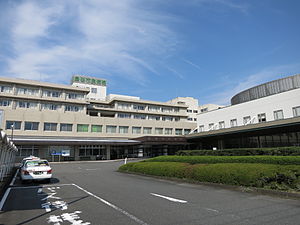
Municipal Shimada Municipal Hospital (しりつしまだしみんびょういん) is the hospital which Shimada-shi in Shimada-shi, Shizuoka runs.
Table of contents
History
I establish - Shimada municipality medical office (1946) on April 11 in 1946.
It becomes the municipal institution by - municipal organization enforcement (1948) on January 1 in 1948.
I am renamed to - Shimada Municipal Hospital (1950) on January 1 in 1950 (20 beds of sickbeds)
- Shimada Municipal Hospital medical examination starts (1957) on December 13 in 1957 (98 beds of public, tuberculosis 52 beds, infection 30 beds, 180 beds in total)
I establish - existing municipal hospital (1979) on April 2 in 1979 (353 beds of public, tuberculosis 15 beds, infection 30 beds, 398 beds in total)
1981 (1981) the beginning to use (445 beds of public, tuberculosis 15 beds, infection 30 beds, 490 beds in total) of April 1 - new ward
I change - bed capacity of it (1983) on August 1 in 1983 (451 beds of public, tuberculosis nine beds, infection 30 beds, 490 beds in total)
I change - bed capacity of it (1987) on October 8 in 1987 (484 beds of public, tuberculosis 12 beds, infection 30 beds, 526 beds in total)
I change - bed capacity of it (1988) on April 1 in 1988 (698 beds of public, mind 20 beds, tuberculosis 12 beds, infection 30 beds, 760 beds in total)
I change - bed capacity of it (1995) on November 24 in 1995 (694 beds of public, tuberculosis 12 beds, mind 20 beds, infection 30 beds, 756 beds in total)
I change - bed capacity of it (1999) on April 4 in 1999 (694 beds of public, tuberculosis 12 beds, mind 20 beds, infectious disease six beds, 732 beds in total)
I establish - community medicine Service Center (2005) on October 3 in 2005
I change - bed capacity of it (2005) on December 16 in 2005 (481 beds of public, medical treatment 35 beds, tuberculosis eight beds, mind 20 beds, infection six beds, 550 beds in total)
- second opinion outpatient department acceptance starts (2006) on July 1 in 2006
Shimada-shi that is the installer of our House installs the Shimada City nursing technical school in the neighborhood and becomes the training hospital. There is the introduction of the technical school in the Web site of the hospital, too, and there is the link to the Web site of the technical school, too.
Various engines designated
Insurance medical institution (the medical treatment reward score list former)
Emergency notification medical institution
Workmen's accident compensation insurance designation medical institution
Specialist in Maternal Protection law designation
Welfare designation medical institution
The medical institution which is located of the specialist in person with a physical disability welfare method designation
Designated independence support medical institution (rebirth medical care, upbringing medical care)
In addition, Tranpedia is simply not responsible for any show is only by translating the writings of foreign licenses that are compatible with CC-BY-SA license information.
The traffic science museum (こうつうかがくはくぶつかん, English: Modern Transportation Museum) is traffic, a museum about the science which was ever at 3-11-10, Namiyoke, Minato-ku, Osaka-shi, Osaka.
Museum of Transportation where the traffic-related museum in Japan was in Kandasudacho of Tokyo in the early 30s of the Showa era was the only thing. The Japanese National Railways which owned a museum considered whether I install an annex of Museum of Transportation in Osaka District in about 1957, but will install it afterwards as a museum mainly on the display about the traffic in the future as an annex of Museum of Transportation in the present age when is different from Museum of Transportation in the concept.
The opening is realized as Osaka Loop Line completion commemorative project and next will be established Bentencho Station as "the traffic Hall of Science"; October 14, 1961 (preparations were pushed forward for the opening of 〉) on the day of 〈 existing railroad in an anniversary of railway transportation. However, construction was late by the second Muroto typhoon of September of the year, and the opening was opened on postponement, January 21, 1962, the following day. It was a name of "the Hall of Science" at first, but receives the designation of "museum considerable facilities" to fix for museum method Article 29 in March, 1964 [1].
In the beginning of opening, the historic display about the railroad was held in check by process such as the above, and the preservation display of the real railroad carriage was only one steam locomotive and three passenger cars, too. Some stores product about the field of traffic except the railroad moves to this museum afterwards because it was the display constitution that succession and the railroad Museum that it was (Saitama-shi) specialized in the field of railroad according to the name after the historic showpiece is added other than a railroad carriage sequentially, and Museum of Transportation closed at 2006.
The administration at the beginning of opening was consigned to Japan Travel Bureau Foundation by Japanese National Railways, but was changed to the traffic culture promotion foundation which started as an affiliated organization of Japanese National Railways in 1970 [2]. After Japanese National Railways division and privatization, West Japan Railway and East Japan Railway Co. (JR East) succeeded the foundation jointly, but they moved the headquarters in this museum on August 1, 2009 after the Museum of Transportation closing and made a fresh start as the associated organization which independent, West Japan Railway took charge of.
However, the deterioration of facilities, facilities have become small, and build the new railroad Museum in form to expand the plum alley steam locomotive building in Shimogyo-ku, Kyoto-shi [3], and, by 2016, will close a traffic science museum on (in December, 2013 in "Kyoto railroad Museum" name decision [4]), April 6, 2014. As for the store document of the hall, the development of facilities becomes going to be stimulated as part of "Osaka Loop Line remodeling project" about the future usage after the closing [5] to transfer by a new museum. It was 2015, and, about a part of the display vehicle (D51 form steam locomotive, DD13 form diesel, DF50 form diesel), it was announced not Kyoto railroad Museum what was transferred by Tsuyama まなびの railroad building of Tsuyama-shi, Okayama (Tsuyama sector engine garage) [6].
The number of the people of entering a building of 2008 was 289,800 people.
A bureau of this museum was set up in South Gate Building after Osaka station city opened in May, 2011. From July 19, 2014 after the closing to August 17, was shown display a part of the old stored possession in promotion "Fun Fan Festa 2014" in the summer of the facilities [7]; [8].
Chronological table
I am opened in commemoration of - Osaka Loop Line completion (1962) as "the traffic Hall of Science" on January 21 in 1962. The opening attendance was 8,154 people [9].
The second exhibit space opens (1984) as exhibit space of two - diesels in 1984. It was the exhibition only for special days including the anniversaries of railway transportation at first [10].
Communication Bridge to bind the second exhibit space and main building together is completed with the display of the -80 system train (1986) in March in 1986 and makes the second exhibit space permanent construction [10].
It becomes the possession facilities of West Japan Railway with division and privatization of - Japanese National Railways (1987) on April 1 in 1987.
I am renamed to - "traffic science museum" (1990) on July 20 in 1990.
I redecorate the entire surface of - exhibition room (1993) in 1993 [11].
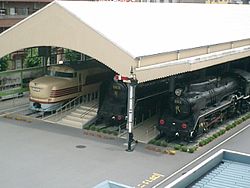
I build - outdoors exhibit space "platform plaza" (2002) in July in 2002.
I introduced - ICOCA electronic money (2008) on March 18 in 2008 and became able to enter it in ICOCA (Suica which I used by electronic money and a railroad ride mutually became able to enter it from the use of electronic money aspect each other starting date).
I close at April 6 with repair, expansion to Kyoto railroad Museum of the - plum alley steam locomotive building (2014) in 2014.
Display
The exhibit space was three of indoor exhibit space, outdoor exhibit space, the second exhibit space. I explain display constitution at the time of the closing as follows.
The real thing of the ML-500 form linear motor car was displayed in the neighborhood of entrance of the indoor exhibit space. There was "ポッポシアター" where conductor robot "ポッポ" introduced the step of the railroad to with a picture "the old station" which a door was contained, and reproduced the station of the early days of the Showa era based on Ministry of Railways document immediately, and there was a long line of the waiting in "driving (I run a model train according to a signal) of the model train" installed in the runner-up on a holiday.
There was the popular "model railroad panorama room" in the depths in this museum. A one-80th scale 16th gaugerailroad model vehicles such as Shinkansen train or the sleeper train ran in a huge diorama. A curator operated a centralized control board and drove by manual operation while adding sleeve notes [11]. Three staffs drove every day in rotation, but there was not the manual, and the appearance turn of a driving train and the vehicle, the commentary contents varied, too [11]. The daily driving number of times at the time of the closing was Saturdays, Sundays, and holidays five times three times on weekdays.
In the second exhibit space, a diesel, a maintenance of tracks apparatus were displayed "the world car window" to introduce world train service to with a picture with structure to connect with indoor exhibit space in an exclusive passage. The north exit gate to be connected directly with matched Bentencho Station north exit wicket. The beginning of establishment could purchase the admission ticket of this museum with the ticket vendor of the belt line train, too, and there was the entrance by the check in charge of the station wicket, too, but was changed later exclusively for an exit.
On March 20, 2007, some exhibition rooms were reopened. A huge diorama of 8m in height, 7m in width was installed in the fourth room which featured the theme of train scheduling and the structure of the vehicle, and model (1/35) such as 700 system "Hikari rail star" and 223 system trains was deployed. I became able to learn device of the security of the railroad including a signal and the automatic train control (ATS) while doing the control of the model. The driver's cab was really a crew ward place, and a used driving simulator was utilized. A candid camera was equipped with at the top of the model, and driving while I looked at the picture was possible. I was able to see the state that a model ran from a dome established in the diorama center. As for the conventional showpiece including the SL model, a display stand and a commentary panel were renovated.
In addition, exhibits were increased in the "ship, plane, car" display area in March, 2009. The exhibit which increased was displayed in Museum of Transportation which I closed, and is bicycles, the motorcycles such as plane engine "ハ 45" (誉) "JO-1" and Benz the first car "Benz motor Waagen" (reproduction), a "ミショー-type bicycle" "pedicab".
The reading room was installed, too and was able to read a book, a document about traffic, the transportation if it was a research purpose. As a general rule, it was impossible of copying in an open room only on Saturdays, Sundays, and holidays, but an on-line collection of books search became possible.
Main showpiece (at the time of closing)
Example platform plaza (May, 2005 photography) of the showpiece
The platform plaza inside
"→" lower than are transference after the closing.
It is made in 1800 form steam locomotive 1801st unit (to 40 of the old turn the reconstruction, a railroad monument) 1881 and installs it in 1964 [15]. → Kyoto railroad Museum [14]
It is made in 230 form steam locomotive 233rd unit (railroad monument) 1903 and installs it in 1967 [16]. → Kyoto railroad Museum [14]
It is made in スハシ 38 form 3 等食堂合造車 スハシ 38 102 (it becomes use, aerial number sushi 28 301 as a dining room in the opening original hall) 1933. It was displayed from the opening to closing. → Kyoto railroad Museum [14]
マロネフ 59 form 2 is made in bed train with brake vans マロネフ 59 1 (a 14 Royal carriage and same shape-type car) 1938. It was displayed from the opening to closing. → Kyoto railroad Museum [14]
I install a 21 form control motor car (Hakata) (0 system Shinkansen train) in 21-1 (machine inheritance eleventh, railroad monument), 1978 [19]. → Kyoto railroad Museum [14]
I install a 16 form extra charge green car (old first class car) (0 system Shinkansen train) in 16-1 (machine inheritance eleventh, railroad monument), 1978 [19]. → Kyoto railroad Museum [14]
35 form normal buffet 合造車 (0 system Shinkansen train) 35-1 (machine inheritance eleventh, railroad monument), 1978 setting [19]. → Kyoto railroad Museum [14]
I install a 22 form control motor car (Tokyo) (0 system Shinkansen train) in 22-1 (machine inheritance eleventh, railroad monument), 1978 [19]. → Kyoto railroad Museum [14]
It is made in San Francisco cable car the 61st car 1907. Was donated to Osaka-shi from San Francisco City that was a sister city in 1959, and was deposited for 1,963 years by the traffic Hall of Science [24]; [25]. It is existence only for the preservation car of the San Francisco cable car outside the mainland U.S. [26]. After closing, Osaka-shi of the owner examines the gratuitous loan to the private company [24].
The display vehicle that was removed before closing
C53 form steam locomotive 45 (I install it in the beginning of opening and transfer it to plum alley steam locomotive building later)
マロテ 49 form observation car マロテ 49 2 (it is original and performs the opening of 改番 in マイテ 49 2 in setting, 1987 and returns the car family register)
29 better 29 form dining car better 107 1966 setting [16]. It wanted to be used as a dining room in the halls, and [27] was removed on the occasion of pear 20 form preservation of 1980 [20].
I retain it from the train クモハ 100 form - opening of Japanese National Railways 101 origin to closing. Become the form that the structure of the vehicle can see through; again of top and bottom and the pantograph door the visitors were able to demonstrate opening and closing it [11].
Including an EF58 form electric locomotive [9] established at the time of these others, opening, the added Shinkansen 0 system train (1964 setting [1]), 20 system passenger car (1967 setting [16]), size of the original replica of the 581 system train (1968 setting [16]) existed afterwards, but, with a halfway display substitute, are removed before closing.
I was able to drive between Fukuchiyama Line (JR Takarazuka Line) Amagasaki Station - Takarazuka Station, but stopped after JR Fukuchiyama Line derailment of 2005. I changed a section from a renewal of March 20, 2007 between Chuo Line high speed Mitaka Station - Nishi-Hachioji Station of JR East and reopened.
A railroad crossing: A warning signal sounds when I push the button, and a crossing gate operates.
Various railroad signal: 3 lights type signal .5 light type signal, broadcast signal, rotary form obstruction warning indicator, 入換信号機, preliminary route indicator.
Inversion flap type guidance indication machine: I display the indication machine that I used at Ayabe Station from Japanese National Railways Era. The most moving passage was able to really do an operation experience with a console [11]. In addition, as for the indication machine for Tokaido, the Sanyo Shinkansen used as operation experience business at first (thing before the wish appearance), indication was displayed in a fixed state after indication machine introduction of Ayabe Station.
Corner (I displayed a railroad model on behalf of a regulation cap and the railroad companies) that introduces the summary of the Kansai area railroad companies
Showpiece image e
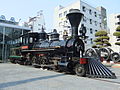
Japanese National Railways 7105 steam locomotive "義經号"
Japanese National Railways 1801 steam locomotive
Japanese National Railways 233 steam locomotive
Japanese National Railways D51 2 steam locomotive
Japanese National Railways C62 26 steam locomotive
Japanese National Railways DD13 638 diesel
Japanese National Railways DD54 33 diesel
Japanese National Railways DF50 18 diesel
クハ 151 form maegashira part Size of the original mock-up
A movie was "the setting sun of ALWAYS 3 sequel to", and a キハ 81 form diesel train was used in the location in the scene of limited express "echo" (151 system train) in the car [32]. This is because it was the structure that facilities of the キハ 81 form in the car followed a 151 system train.
When there was the electric Hall of Science, it is said that a wrong call to say "when is time for planetarium?" happened quite often.
Several months just before the closing before ^it later, the display of the storehouse soup stock article which I was not able to look at was performed generally.
The business as the dining room (I cook it in the inside of car and contribute it) became Saturdays and holidays and the chisel during the long-term off period of the school in the ^ later years.
Because the above スハシ 38 (sushi 28) form had already existed ^, kitchen facilities were removed by a purpose called the expansion of the attendant food space, and seats were built more by the trace (they can confirm it in the photograph of the "history of traffic science museum 50 years" p.12 publication in the car).
"Traffic science museum 50 years history of" traffic science museum, 2013 (sketch it in the footnote with "the 50 years history")
The Osaka traffic Hall of Science which opened "railroad PICT rial" electricity car meeting for the study, March, 1962 issue (consecutive number of volumes 129) Yutaka Yoshikawa
A "railroad PICT rial" electricity car meeting for the study, a May, 2005 issue (consecutive number of volumes 761) special feature: Dining car
In addition, Tranpedia is simply not responsible for any show is only by translating the writings of foreign licenses that are compatible with CC-BY-SA license information.
 Municipal Shimada Municipal Hospital