검색어 江波에 대한 글을 관련성을 기준으로 정렬하여 표시합니다. 날짜순 정렬 모든 글 표시

2017년 2월 1일 수요일

Hiroshima Electric Railway Hakushima Line

Hiroshima Electric Railway Hakushima Line

Hakushima Line
910 which stops at the Hakushima Line Hatchobori streetcar stop
Basic information
Country Japanese flag Japan
The location Hiroshima-shi
The starting point Hatchobori streetcar stop
Terminal Hakushima streetcar stop
The number of the stops 5
The opening of business 1912November 23
Operator Hiroshima Electric Railway
Route specifications
Route distance 1.2 km
Gauge of a track 1,435mm (standard gauge)
The number of the tracks Double track
Electrification method Direct current 600V imaginary train line method
The maximum speed 40km/h
I display a template
Streetcar stop, facilities, connection route
The east side (the left): The Hiroshima Station area
The west (the right): Nishihiroshima (Koi)Miyajima
Ujina, 江波方面
uSTRq
The main line
W1 Hatchobori
uBHF
W2 In front of House of learning for women
uBHF
W3 In front of Shukkei-en Garden
uBHF
W4 In front of family court
uSTR
↑Double track / single line↓
uKBHFe
W5 Hakushima
Hakushima Line Hakushima streetcar stop

The Hakushima Line (I do not win it) is the orbit route that Hiroshima Electric Railway holds. By a route of 1.2km in total length to link Hakushima to Hatchobori, the whole line runs Naka-ku, Hiroshima-shi, Hiroshima. One of the establishment of a business route of Hiroshima Electric Railway.

Table of contents

Summary

It was the route that there was as well as the main line from opening of business those days, but did not perform the direct driving with other routes alone for a long time in the city line. In 2013 101 years after the establishment of a business, direct driving to 江波電停 was started.

Autocrat driving and PASPY are precedent (trial) introduced routes. Because the total extension is short, as for the fare, in the case of a ride, only Hakushima Line is limit 110 yen for adults, infant 50 yen (when I sit with the main line and take it normal 160 yen for adults, infant 80 yen).

Hakushima Station of the Astra irregularity in is approximately 1km away from the Hakushima streetcar stop of the terminal. The abolition of the route was proposed in 2007 by Hiroshima Chamber of Commerce [1]. However, Hiroshima-shi does an intention expression "to continue by all means" for this proposal, and Hiroshima Electric Railway expresses it saying "I will cope according to the intention of the city" [2].

Route data

  • Route distance (working kilometer): 1.2km
  • Gauge of a track: 1,435mm
  • The number of the streetcar stops: 5 (I include origin-destination)
  • Double track section: The whole line (except the neighborhood of Hakushima streetcar stop)
  • Electrification section: The whole line (direct current 600V)

Service form

Only Route 9 is operated. It is the lapel service in the line of Hatchobori - Hakushima, but 7 coming and going (6 commutes on a holiday) are carried out direct driving basically between 江波 (江波線) -8 orders moat - Hakushima from February 15, 2013.

The 1000 form of the super low floor conjunction car gets use, and 900 form .1900 form of the motorcycle is used for 4 Japanese-Chinese coming and going about the flight in other morning and evening among direct driving between 江波 - Hakushima. The latter use just made the forwarding from the Hakushima line after transfer and the commercial operation from 江波車庫 of the vehicle which ran in Hakushima Line in reply to the Hakushima line to 江波車庫 commercial operation. The exclusive direction curtain was prepared by the direct driving service, but the shuttle service of the Hakushima inside the line is limited only to this motorcycle 2 form only for these 2 forms a supporting motorcycle as of April, 2013, too.

705 and 713 of the 700 form were used from a use of PASPY start of the Hakushima Line of 2008 frequently for a while, and two cars of one 700 form and 900 form or one 1900 form in total or two might be 700 form by the driving at the daytime at the time. This was a vehicle of 江波車庫, and I limited it to these six cars until all being on the register roll vehicles did PASPY correspondence, and, as for what PASPY leader was attached to, use became you other than 705 and 713 because it was only 912, 913, 1913, 1915. In addition, I served as the operational examination after the PASPY apparatus correspondence, and today's, each vehicle of 700 form and the 800 form of 江波車庫所属 took use to flat Japan-North Korea rush tide of the times use of intervals from February 9, 2009 to March 1.

200 form was managed 100 form in the fall and winter in the spring and summer from the late 1980s through mid-2000s on a holiday. A similar thing is performed now in Yokogawa Station - 江波間 of Route 8.

History

It is before being bombed.
After being bombed.
Around Hatchobori before and after the being bombed. The Aioi Street that the main line goes along a road to cross. A train went to the second way in those days from the left. A course on one right side is arranged after the war as a route as of the Hakushima Street clogging.
  • Hatchobori - Hakushima interval starts a business as a Tokiwa Bridge flight (1912) on November 23 in 1912. It was a route to go along on the way which filled up old outside moat of Kyouguchi door front that is Hiroshima-jo Castle, and was maintained in those days.
  • Introduction of the view gel is carried out (1940) ahead of other routes in April in 1940.
  • It becomes the whole line interruption than A-bomb throwing down to Hiroshima-shi (1945) on August 6 in 1945.
  • The whole line restores (1952) in March in 1952. Of the current route is located.
  • I start the use of the bus without a conductor with 900 form other than a wide train (1969) ahead of a route in 1969.
  • I introduce "PASPY" (IC travel card) other than a wide train (2008) prior to a route on March 1 in 2008. A ride in West Japan Railway "ICOCA" was enabled at the same time (and thereafter 700 form that was not used comes to be used in the commercial operation).
  • I spend super low floor conjunction car 1000 form (2013) on February 15 in 2013. Some trains of Route 9 start entry of to 江波 in main line, 江波線経由.

List of streetcar stops

 
The route that I looked at from the Hakushima Line inside of car

Naka-ku, Hiroshima-shi, Hiroshima is located with all streetcar stops [3].

Number Streetcar stop name Station interval
Kilometer
Business
Kilometer
System Connection route
W1 Hatchobori - 0.0         Hiroshima Electric Railway: The main line
W2 In front of House of learning for women 0.5 0.5    
W3 In front of Shukkei-en Garden 0.2 0.7    
W4 In front of family court 0.3 1.0    
W5 Hakushima 0.2 1.2    

Allied item

Footnote

[Help]
  1. It is ripple asahi.com June 21, 2007 in ^ wide Dianbai island line, sudden abolition plan.
  2. "Chugoku Shimbun-sha" June 27, 2007 negative for the ^ "Hakushima Line abolition" in the city.
  3. I refer the streetcar to "a streetcar stop" in ^ Hiroshima Electric Railway, and Miyajima Line which is a rail line is referred to "a station".

Outside link

This article is taken from the Japanese Wikipedia Hiroshima Electric Railway Hakushima Line

This article is distributed by cc-by-sa or GFDL license in accordance with the provisions of Wikipedia.

Wikipedia and Tranpedia does not guarantee the accuracy of this document. See our disclaimer for more information.

In addition, Tranpedia is simply not responsible for any show is only by translating the writings of foreign licenses that are compatible with CC-BY-SA license information.

2016년 11월 22일 화요일

Hiroshima region meteorological observatory

Hiroshima region meteorological observatory

Hiroshima region meteorological observatory
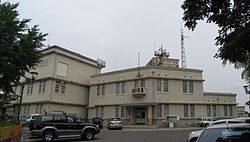
Hiroshima National Government Building No.4.JPG
Hiroshima region meteorological observatory (Hiroshima combination Government building Building No. 4)
Classification Local Meteorological Observatory
Local forecast center government agency
Jurisdiction Hiroshima
TottoriShimaneOkayama
The location 6-30, Kamihacchobori, Naka-ku, Hiroshima-shi, Hiroshima
Link Official site

The Hiroshima region meteorological observatory (whether Hiro Island Chiho is isolated, and you carry it) is Local Meteorological Observatory in Naka-ku, Hiroshima-shi, Hiroshima. It is the jurisdiction of the Osaka district meteorological observatory and is forecast center government agency unifying the Chugoku districts except Yamaguchi.

Table of contents

Summary

I perform the weather of Hiroshima above the ground, the observation of the biological season, the seismic intensity observation of the earthquake and announce a weather forecast, weather warning, a warning, information, earthquake information, the Earthquake Early Warning, an eruption warning, the eruption forecast in a weather forecast, a week and perform the monitoring of the weather condition of the Chugoku district except Yamaguchi as the district forecast center.

In addition, Shimonoseki Local Meteorological Observatory having jurisdiction over Yamaguchi of the same Chugoku district belongs to the local forecast ward of Fukuoka not Hiroshima, and the district meteorological observatory is Fukuoka not Osaka, too.

History

Hiroshima Government building of the Meiji period. The first meteorological observatory establishment place.
An old meteorological observatory of 江波. 現江波山気象館.
  • The Hiroshima meteorological observatory foundation (1879) - Hiroshima Prefectural for 1,879 years on January 1.
  • I am renamed to - Hiroshima Prefectural Hiroshima first prize meteorological observatory (1888) on July 1 in 1888.
  • A move [1] (1892) new 1892 in December in - 広島市国泰寺村 (existing Chidacho, Naka-ku).
    • The concrete place is unidentified.
  • I am renamed to - Hiroshima Prefectural Hiroshima meteorological observatory (1919) on May 15 in 1919.
  • A move (1935) new 1935 on January 1 in - 広島市江波町 (existing Ebaminami, Naka-ku).
  • It becomes - government management transfer, the Central Meteorological Observatory Hiroshima meteorological observatory (1939) on November 1 in 1939.
  • I am renamed to - Hiroshima region meteorological observatory (1943) on November 15 in 1943.
  • I am renamed to - Hiroshima district meteorological observatory (1945) on August 11 in 1945. I add a meteorological observatory.
  • I abolish - Hiroshima district meteorological observatory meteorological observatory (1949) on June 1 in 1949.
  • I am renamed to - Hiroshima region meteorological observatory (1949) on November 1 in 1949.
  • I move to Kamihacchobori, Naka-ku of - present location (1987) on December 22 in 1987.

Weather forecast division

Location

Means of transportation

  • Hiroshima Electric Railway streetcar stop "Tachimachi" getting off, about 10-minute walk.

Local forecast ward jurisdiction meteorological observatory

Tottori region meteorological observatory

Tottori region meteorological observatory
Classification Local Meteorological Observatory
Jurisdiction Tottori
The location 109, Yoshikata, Tottori-shi, Tottori
Link Official site

The Tottori region meteorological observatory (whether you take it, and Chiho is isolated, and you carry it) is Local Meteorological Observatory in Tottori-shi, Tottori. It is the jurisdiction of the Osaka district meteorological observatory.

History

Weather forecast division

East Tottori

The western part in Tottori


Matsue Local Meteorological Observatory

Matsue Local Meteorological Observatory
Classification Local Meteorological Observatory
Jurisdiction Shimane
The location 7-1-11, Nishitsuda, Matsue-shi, Shimane
Link Official site

Matsue Local Meteorological Observatory (whether Matsue Chiho is isolated, and you carry it) is Local Meteorological Observatory in Matsue-shi, Shimane. It is the jurisdiction of the Osaka district meteorological observatory.

History

  • I install it (1939) as - Osaka district meteorological observatory Matsue meteorological observatory on November 1 in 1939.
  • I change a name of it to - Matsue Local Meteorological Observatory (1957) on September 1 in 1957.
  • I move to the new Government building of - existing location (1979) on November 1 in 1979.

Weather forecast division

East Shimane

West Shimane

Oki


Okayama region meteorological observatory

Okayama region meteorological observatory
Classification Local Meteorological Observatory
Jurisdiction Okayama
The location 1-36, Kuwadacho, Kita-ku, Okayama-shi, Okayama
Okayama region combination Government building
Link Official site

The Okayama region meteorological observatory (whether Kayama Chiho is isolated, and you carry it) is Local Meteorological Observatory in Kita-ku, Okayama-shi, Okayama. It is the jurisdiction of the Osaka district meteorological observatory.

History

  • I establish it (1890) as an Okayama Prefectural meteorological observatory in the old Okayama-jo Castle within the castle of - Uchisange, Okayama-shi on November 15 in 1890.
  • I move to - 58, Uchisange, Okayama-shi (1896) on June 1 in 1896.
  • It becomes - government management transfer (1938) on October 1 in 1938 and is renamed to Okayama meteorological observatory.
  • I move to - Tsushimakuwanokicho, Okayama-shi (1949) on April 16 in 1949.
  • I am renamed to - Okayama region meteorological observatory (1957) on September 1 in 1957.
  • I move to the present location on - 1-36, Kuwadacho, Okayama-shi Okayama region combination Government building the fifth floor (1982) on October 1 in 1982.

Weather forecast division

South Okayama

North Okayama

Footnote

[Help]
  1. ^ a b Tadashi Yoshida Jiro "Hiroshima guide" Makoto Tomota truth temple, 1913. August 5, 2014 reading.

Allied item

Outside link

This article is taken from the Japanese Wikipedia Hiroshima region meteorological observatory

This article is distributed by cc-by-sa or GFDL license in accordance with the provisions of Wikipedia.

Wikipedia and Tranpedia does not guarantee the accuracy of this document. See our disclaimer for more information.

In addition, Tranpedia is simply not responsible for any show is only by translating the writings of foreign licenses that are compatible with CC-BY-SA license information.
2017년 6월 11일 일요일

Ohashi, Showa (Hiroshima-shi)

Ohashi, Showa (Hiroshima-shi)

The land bridge that Ohashi, Showa (しょうわおおはし) appears in the Tenma River of Hiroshima-shi, Hiroshima. I consist of two bridges of an up line (the upper classes side) and the down line (the down stream side).

Ohashi, Showa
Showa Big Bridge at Hiroshima 01.jpg
From the down stream
Basic information
Country Japanese flag Japan
The location Hiroshima-shi, Hiroshima
The left bank: The Funairi, Naka-ku - right bank: The Nishi-ku Kannon
Intersection article OtagawaWater systemThe Tenma River
Construction 1944 New Year's ornamental trees bridge, 1951 RC bridge, 1978 steel bridge
Coordinate 34°22'N 37.6 seconds 132°25'E 56.6 seconds / 34.377111 degrees N 132.432389 degrees E / 34.377111, 132.432389
Structure specifications
Form Connection simplicity composition I girder x2 between 5 diameters
Materials The upper part: Steel bridge; The lower part: RC structure
Full length 208m, 211m
Width 13m *2
Item concerned
List of bridges - Bridge of each country - Form of the bridge
I display a template

Table of contents

Summary

Originally it was a bridge made for wartime, and the current bridge was rebuilt in 1978. It is a bridge built over Hiroshima municipal road haze Kogo line (width 23m) [1], and it was a bridge appearing on the most down stream side of the Tenma River, but Kannon Ohashi is completed in 2014 until the Heisei early days.

There is Hiroshima Prefectural Hiroshima commercial high school on the Higashizume down stream side and arrives at Kichijima Bridge when wide electric Funairiminami-cho stop goes more when I go to the east more along the way. I arrive at Kogo Bridge when I just go straight from west final stage in the Hiroshima synthesis ground when I follow the airport street of 250m ahead 250m from Nishizume to the south.

History

It was prepared land early in Showa, and Kannon who is these both sides and Funairi, 江波 are the land which was maintained when I would maintain a big munitions factory zone to all the Otagawa water system river mouths planned after World War I [2]. At this chance, by the invitation of the prefecture side and a request of the Great Japanese Empire navy, the construction of shipbuilding, the engineering factory (current Mitsubishi Heavy Industries Hiroshima mill) of Mitsubishi Heavy Industries was decided in 江波 [2]. Therefore the residential area for the factory worker of Mitsubishi was secured by Kannon and Kogo Shinkai, and the Mitsubishi side requested the construction of the communication bridge for administration from there to Mitsubishi factory of 江波 [2]. 1/2, Hiroshima and Hiroshima-shi bore by 1/4 each (1944), Mitsubishi in 1944, and this Ohashi, Showa and Kogo Bridge were constructed as a simple temporary tree girder [2].

I am bombed by A-bomb throwing down to Hiroshima-shi (1945) on August 6 in 1945 (from the center of an explosion 2.85km). A refugee went over to the west to Sara Kannon without the damage let alone collapse of bridge one after another from 江波 [3]. However, in September of the year, it has fallen by the flood caused by the Makurazaki typhoon [2]. The bridge built over the Tenma River by the flood caused by this Makurazaki typhoon and Akune typhoon of October of the year leaves Yokokawa Bridge of upper reaches and falls all [3].

Therefore, restoration construction was decided early and was built a bridge again (1951) (1947) as a steel reinforced concrete girder for exclusive use of the roads in start of work, 1951 in 1947. In (1979), the side of upper reaches, Hiroshima-shi, the down stream side are changed to the current thing consisting of 2 bridges with Tenma River building a breakwater maintenance and haze Kogo line maintenance afterwards in 1979 by the Ministry of Construction China Regional Construction Bureau.

Gallery

Footnote

Reference materials

Allied item

This article is taken from the Japanese Wikipedia Ohashi, Showa (Hiroshima-shi)

This article is distributed by cc-by-sa or GFDL license in accordance with the provisions of Wikipedia.

Wikipedia and Tranpedia does not guarantee the accuracy of this document. See our disclaimer for more information.

In addition, Tranpedia is simply not responsible for any show is only by translating the writings of foreign licenses that are compatible with CC-BY-SA license information.